
Buying molded PEEK parts is one of those procurement tasks where the spec sheet alone doesn’t protect you.
Two suppliers can quote the same resin family and the same drawing—and you still end up with different scrap rates, different dimensional drift after assembly, or a part that passes incoming inspection but warps after a few thermal cycles.
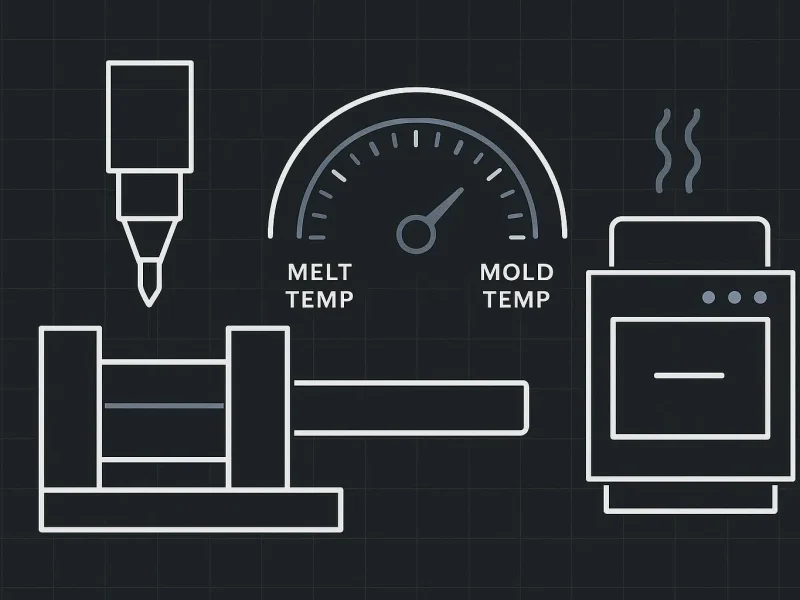
That’s because PEEK’s performance is tightly tied to how it’s processed—especially how moisture is handled, how the melt is heated, how the mold is temperature-controlled, and how crystallinity is developed (or not developed) during cooling. If any of those variables drift, the “window” gets narrow fast.
This guide is written for procurement and sourcing managers (and anyone supporting them in engineering/quality). It explains the processing window in plain language, provides defensible typical ranges from reputable sources, and gives you a supplier-qualification checklist you can use before you place a production PO.
⚠️ Warning: Processing conditions vary by grade (unfilled vs. reinforced), part geometry, tooling design, and machine capability. Treat all numbers below as typical starting ranges, and validate against the resin supplier’s datasheet and your supplier’s proven process.
What “processing window” means for PEEK (in procurement terms)
This section defines the PEEK injection molding processing window in practical buyer-side terms.
A PEEK injection molding processing window is the range of conditions where a supplier can repeatedly mold parts that meet:
- dimensional tolerances and flatness
- mechanical performance requirements
- cosmetic/defect requirements (voids, splay, burn marks, black specs)
- consistency across lots (low drift as raw material batches and machine setups change)
For procurement, the window is also a risk boundary:
- Wide window → easier scale-up, fewer deviations, more suppliers can meet it.
- Narrow window → higher scrap risk, longer qualification, and more dependence on a supplier’s discipline.
A supplier with a strong PEEK window can show you evidence they control the variables below, not just claim they do.
Quick definitions: crystallinity, Tg, and why you should care
PEEK is a semi-crystalline thermoplastic. In practice, that means a molded part can end up with different internal structure depending on how it’s cooled and heat-treated.
- Tg (glass transition temperature) is roughly the point where the polymer transitions from “glassy” to “rubbery” behavior.
- Crystallinity is the ordered portion of the polymer structure; it affects shrinkage, stiffness, chemical resistance, and long-term dimensional stability.
Even if you never measure crystallinity directly, you feel it as a buyer: it shows up as shrink variation, warpage risk, and “why did this part change size after 48 hours?” surprises.
If you’re sourcing PEEK for high-temperature, chemical, or precision applications, the supplier’s ability to control crystallinity is part quality—full stop.
The core PEEK injection molding processing window (typical ranges)
This section gives a “starter map” of the window and (more importantly) explains what to watch.
PEEK injection molding melt temperature (typical)
PEEK requires high melt temperatures. Plastics Technology summarizes common guidance as ~350°C to 400°C barrel temperatures for molding PEEK (grade- and machine-dependent) in .
Why this matters to procurement:
- A supplier’s press must be rated for sustained high-temperature processing, not “it can hit the number once.”
- Temperature stability is a proxy for repeatability. A process that constantly “hunts” for temperature is rarely stable in dimensions.
What to ask a supplier:
- “What is your proven barrel/nozzle profile for this part and grade?”
- “How do you verify actual melt temperature (not only setpoints)?”
PEEK injection molding mold temperature (the variable that separates ‘okay’ from ‘reliable’)
Mold temperature is not a footnote for PEEK; it’s the main lever controlling crystallinity and stability.
Plastics Technology cites mold temperatures typically in the ~170°C to 200°C range (grade-dependent) in the same 2019 article. Victrex’s grade-specific datasheet for FG™ POLYMER 200 also lists 170°C to 200°C as typical mold temperature guidance: .
Why this matters to procurement:
- Mold temperature control often signals process maturity (heater capability, insulation, monitoring, mold design for uniformity).
- If a supplier is “molding PEEK” but running low mold temperatures to simplify tooling, you may get parts that look fine at inspection but drift later.
What to ask a supplier:
- “How do you measure the actual mold surface temperature?”
- “What heat-transfer system do you use (oil vs. electric), and how do you ensure uniformity across cavities?”
PEEK drying before injection molding (non-negotiable)
PEEK pellets can pick up moisture from the environment, and moisture can show up as defects and property issues.
Plastics Technology gives typical drying guidance as 2–3 hours at 150°C–160°C and a target residual moisture content of <0.02% in its 2019 PEEK molding article.
Procurement implication:
- If a supplier can’t explain their dryer type, dew point, staging controls, and “dryer-to-throat” handling, you should assume higher variability.
What to ask a supplier:
- “Do you dry by hopper dryer or tray? What dew point does your system hold?”
- “How do you prevent re-absorption during staging and changeovers?”
Beyond temperatures: the controls that decide whether the window is real
If you only validate melt and mold temperatures, you’ll still get surprised. The controls below are where many quality problems are born.
Residence time and thermal history
At high processing temperatures, time becomes a variable. A stable process controls how long the polymer spends at elevated temperatures.
What procurement can do:
- Ask for the supplier’s standard approach to minimizing long “soaks” in the barrel (e.g., startup/shutdown procedures).
- Ask whether the press is dedicated to high-temp polymers or frequently switched.
Supplier signals to look for:
- clear start-up and purge procedures
- documentation of changeovers and cleaning
- a process that doesn’t rely on “hero operators”
Injection speed, shear, and packing
PEEK is viscous. Filling and packing decisions drive:
- voids and short shots (under-packed)
- flash and stress (over-packed)
- orientation effects (especially in reinforced grades)
You don’t need the operator’s exact speed/pressure values—but you do need evidence the supplier can hold a stable fill/pack pattern.
Practical procurement questions:
- “What’s your process-control plan for fill and pack? Do you use documented setup sheets?”
- “How do you monitor a process drift (e.g., shot-to-shot weight, cavity pressure if available, in-process inspection cadence)?”
Gate sizing, flow, and shear: why tooling design matters
PEEK is unforgiving. Getting stable fill and stable pack often depends on gating.
Plastics Technology emphasizes using large gates and cites a rule-of-thumb: minimum gate thickness around 2/3 of the maximum section thickness, with minimum thickness around ~1 mm for unfilled PEEK and ~2 mm for compounds (2019).
Procurement implication:
- If a supplier is trying to run PEEK through restrictive gating to “make it work,” you may see more frequent tuning, higher scrap, and bigger lot-to-lot drift.
What to ask a supplier:
- “Was the tool designed specifically for PEEK flow and packing, or adapted from another resin?”
- “What defects does your gating strategy prevent (voids, sinks, warp, burn)?”
Cleanliness and contamination control
At PEEK processing temperatures, contamination from other polymers or residues becomes a real defect source. Plastics Technology lists cleanliness as one of the five key factors and warns that other polymers can degrade at PEEK’s processing temperatures, leading to black specs and other defects (2019).
Procurement implication:
- A supplier’s contamination controls are part of your incoming quality risk.
What to ask a supplier:
- “Is the press dedicated to high-temp materials? If not, what’s the purge/cleaning validation?”
- “What’s your regrind policy for PEEK? Is regrind allowed at all for this program?”
Cooling uniformity and “hidden” warpage risk
Warpage is rarely random. It’s usually a consequence of:
- uneven cooling
- uneven crystallinity development
- asymmetrical packing
Procurement-friendly way to evaluate this:
- Ask if the supplier has ever had to add fixtures or secondary controls to prevent warpage.
- Ask what they do to ensure cooling is balanced (especially on thick sections and deep cores).
If they can’t explain this in plain language, that’s usually not a good sign.
Annealing: when it helps, what it changes, and how to specify it safely
PEEK annealing is not a “nice to have.” It can be the difference between a part that stays flat and a part that slowly moves out of spec.
What annealing actually does
Annealing can:
- relieve molded-in stress
- complete or increase crystallinity (depending on the part’s prior cooling history)
- improve dimensional stability over time
It can also:
- cause dimensional change (sometimes more than expected)
- cause distortion if parts are unsupported or unevenly heated/cooled
PEEK annealing guidelines (a defensible baseline)
Plastics Technology gives a common routine for PEEK as 2 hours at 200°C (392°F), noting that this is above Tg and can provide the final increment of crystallinity that molding alone may not achieve: .
How to use this as procurement:
- Treat it as a reference point.
- Require the supplier to propose and document the actual profile they will use for your geometry (including ramp and cooling controls) and to show that it meets dimensional requirements.
Pro Tip: If you specify annealing, consider requiring post-anneal inspection for critical dimensions. It turns annealing from a “black box” into a controlled step.
When annealing is worth considering
Annealing is most useful when:
- you need higher dimensional stability over time
- parts are asymmetric or prone to warpage
- parts will see elevated temperatures in service
- you’re machining molded blanks and want stability between roughing and finishing
How to specify annealing without creating a dispute
If you include annealing on the drawing or PO, clarify:
- whether annealing is mandatory for every lot, or only for certain part families
- whether fixturing is required or allowed
- whether dimensional requirements are as-molded or post-anneal
- what records you expect (e.g., time/temperature record per lot)
What to avoid:
- locking in a single “magic” anneal recipe without grade/geometry context
- assuming annealing will fix defects caused by poor mold temperature control
Procurement checklist: qualify a PEEK molding supplier (before you get stuck)
Use this as a structured RFQ appendix.
To make it easier to apply in real sourcing workflows, the checklist below is written so it can be copied directly into an RFQ and answered point-by-point.
1) Material traceability and certification
Ask for:
- lot/batch traceability from pellet lot to finished lot
- Certificate of Analysis (CoA) and Certificate of Conformance (CoC) per shipment
- clear statement of grade and any reinforcement (unfilled vs. GF/CF)
Why it matters:
- PEEK performance shifts by grade and filler content.
- In regulated environments, traceability is part of your audit trail.
2) Moisture control evidence
Ask for:
- dryer type, dew point capability, and standard work instructions
- how long material can sit between drying and molding before it’s re-dried
3) Mold temperature control and monitoring
Ask for:
- the heating method (oil/electric), monitoring points, and control strategy
- how they verify actual mold surface temperature
- how they handle temperature uniformity across cavities
Red flag:
- only reporting heater setpoint with no verification.
4) Proven process documentation (repeatability over heroics)
Depending on industry, request:
- first article inspection (FAI)
- control plan for critical dimensions
- process change control and notification procedure
5) Contamination and regrind policy
Ask directly:
- whether regrind is used (and at what percentage, if allowed)
- whether equipment is dedicated
- cleaning and purge approach between materials
As a general principle, the higher the criticality (medical/semiconductor/aerospace), the more you want explicit “no regrind” rules unless approved.
6) What a credible supplier answer sounds like
Strong suppliers tend to answer like this:
- “Here’s our drying method, dew point, and handling.”
- “Here’s how we control mold temperature and verify surface temperature.”
- “Here’s our gating strategy and why it prevents these defects.”
- “Here’s our contamination prevention and regrind policy.”
- “Here’s what we measure in-process and how we handle drift.”
Weak suppliers tend to answer like this:
- “We mold PEEK all the time” (with no details)
- “We’ll adjust until it works”
- “We don’t have those records”
How to write a PEEK molding requirement suppliers can actually meet
If you put the wrong things on the PO, you’ll get quotes you can’t compare and promises you can’t enforce.
Consider specifying:
- resin grade and whether regrind is allowed
- required certificates (CoA/CoC), traceability level
- whether annealing is required, and whether acceptance criteria are post-anneal
- critical dimensions and measurement method (CMM, fixtures, sampling)
Avoid specifying:
- a single melt or mold temperature setpoint unless you are referencing a specific grade datasheet and tool setup. Better: require suppliers to submit and control their proven window.
Where Jekin Polymer fits (light brand mention + internal resources)
If you’re early in supplier discovery, it helps to start with suppliers who already specialize in high-performance polymers and can talk fluently about the controls above.
If you need help scoping a PEEK program (material choice, manufacturability, or supplier expectations), you can reach Jekin Polymer via the site’s contact page.
FAQ
Is PEEK injection molding “standard,” or does it require special equipment?
Many PEEK parts can be molded on conventional injection molding machines if the equipment can maintain the required high temperatures and the supplier has disciplined controls. Plastics Technology lists the critical controls and typical high-temperature range in its 2019 PEEK molding factors article.
Should I always require annealing for molded PEEK parts?
Not always. Annealing can improve stress relief and dimensional stability, but it can also change dimensions. Plastics Technology’s 2020 annealing article provides a common PEEK routine (200°C for 2 hours) and warns about dimensional change.
A practical approach is to require annealing only when the part’s function or tolerance stack truly needs it, and then require post-anneal inspection.
What’s the single biggest red flag when qualifying a PEEK molding supplier?
Vagueness. If a supplier can’t explain their drying approach, mold temperature verification, contamination controls, and gating/packing strategy in a way that maps to defects and stability—assume the “window” is not under control.
Can I compare two PEEK quotes without understanding processing?
You can compare piece price, but you can’t compare risk. For procurement, the cost difference between a stable process and an unstable one usually shows up later as rework, line stoppages, or supplier switches.
Next steps
If you want a second set of eyes on a supplier’s process claims, ask for their proposed drying and molding window, mold temperature control method, and whether they anneal—and review it against the checklists above.
If you’re sourcing PEEK material or evaluating options, you can start with Jekin Polymer’s broader site overview: jekinpolymer