
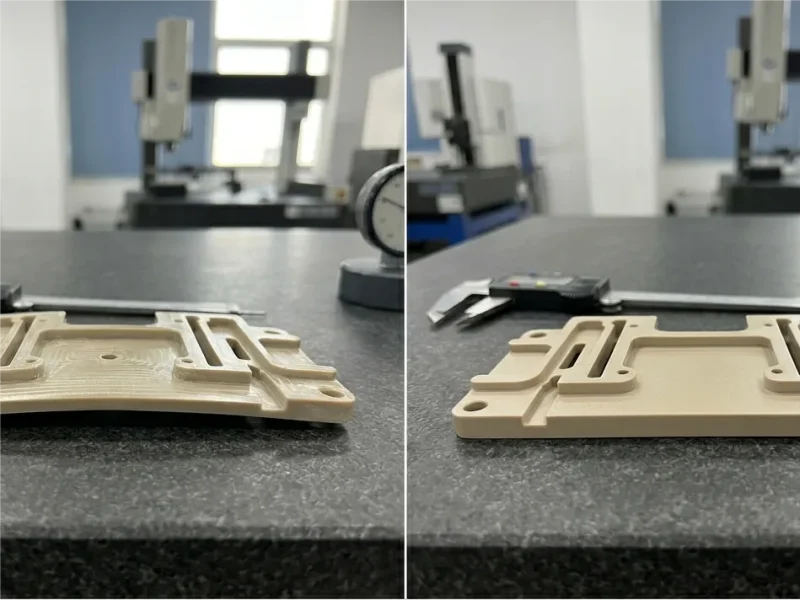
For a source manufacturer of PEEK rods and plates, the core challenge in production lies in managing “Crystallinity Control” and “Internal Stress Relief.”
As a semi-crystalline polymer, PEEK’s dimensional stability is highly sensitive to cooling rates and stress distribution.
Below is a systematic approach to mitigating warpage across three critical stages: Injection Molding, CNC Machining, and Post-Processing.
1. Injection Molding: Precision Thermal Management
Injection molding is often where warpage originates. The objective is to ensure uniform and complete crystallization within the mold.
-
High-Temperature Mold Control (Critical): Mold temperatures must be maintained between 170°C and 200°C. If the mold is too cold, the PEEK melt quenches into an amorphous state, leading to catastrophic dimensional shifts later. We recommend using oil-based mold temperature controllers with PID closed-loop systems to minimize temperature gradients across the mold surface.
-
Optimized Cooling Systems: Traditional straight-line cooling channels often lead to uneven thermal distribution. For precision parts, consider 3D-printed conformal cooling channels that follow the part geometry, ensuring synchronized cooling and significantly reducing residual stress.
-
Gate and Runner Optimization: Utilize larger gates (such as fan gates) to minimize shear heat and flow-induced stress. It is vital to maintain uniform wall thickness wherever possible to prevent asynchronous shrinkage between thick and thin sections.
2. CNC Machining: Symmetrical Cutting and Thermal Regulation
When machining PEEK rods or plates, the removal of material can “unbalance” internal stresses, causing the part to bow or twist.
-
Symmetrical Machining (Balanced Material Removal): Never remove the full allowance from one side in a single operation. Implement a flip-machining strategy: if 5mm must be removed, mill 2.5mm from the top, flip the workpiece, and mill 2.5mm from the bottom. This balanced approach neutralizes stress release.
-
The “Roughing-Annealing-Finishing” Cycle: For high-tolerance components, a three-step process is essential. Perform rough machining leaving a 1–2mm buffer, subject the part to an intermediate annealing cycle to release stresses, and then proceed to final precision finishing.
-
Heat Dissipation: Use sharp, high-positive geometry tools. Opt for high feed rates and moderate spindle speeds to ensure heat is carried away by the chips rather than soaking into the part. Utilize high-pressure air cooling to prevent localized softening.
3. Material Pre-treatment & Post-Processing: Stress Relief via Annealing
Annealing is the most effective method for stabilizing PEEK dimensions for both molded and machined parts.
-
Raw Material Pre-drying: PEEK is hygroscopic. Even trace moisture can cause bubbling and structural degradation during high-temperature processing. Dehumidify resin at 150°C for at least 3–4 hours to ensure a moisture content below 0.02%.
-
Finished Product Annealing: Place the finished or semi-finished parts in an industrial oven. Gradually ramp the temperature to 200°C–220°C (above the Glass Transition Temperature $T_g$ but well below the Melting Point $T_m$). Hold for several hours (depending on wall thickness), then slowly cool at a rate of approximately 5°C per hour until it reaches room temperature. This allows molecular chains to relax and optimizes crystallinity.