
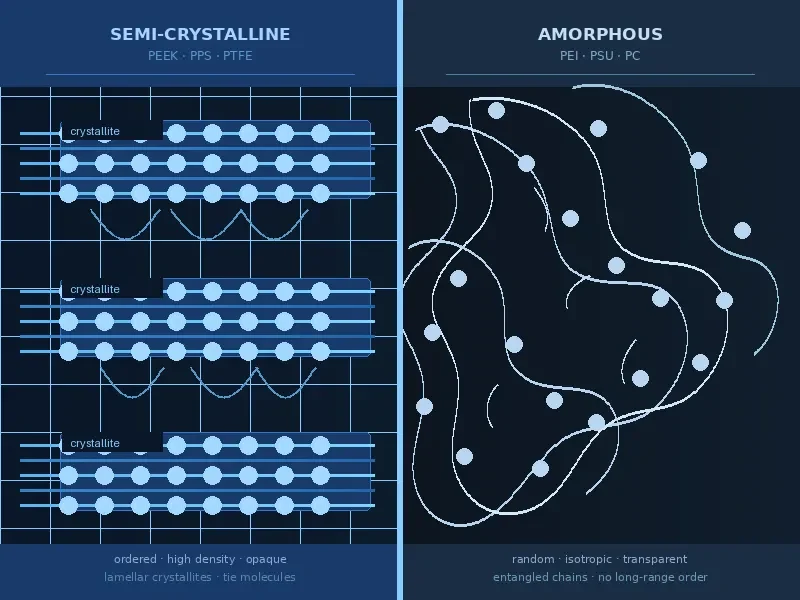
The fundamental distinction between amorphous and semi-crystalline engineering plastics lies in the molecular arrangement of their polymer chains after cooling and solidification. This difference in microstructure directly determines their optical properties, dimensional stability, thermal behavior, chemical resistance, and tribological performance.
To illustrate intuitively, semi-crystalline polymers such as PEEK, PPS, and PTFE can be compared to metals, characterized by highly ordered internal structures, superior mechanical strength, and relatively high molding shrinkage. In contrast, amorphous polymers such as PEI and PSU behave more like glass, exhibiting disordered molecular arrangements, excellent dimensional stability, and high transparency.
1. Microstructure and Optical Transparency
Semi-Crystalline Polymers
Semi-crystalline materials possess regions where polymer chains are arranged in a highly ordered and densely packed manner, forming crystalline domains dispersed within amorphous regions. The interfaces between these phases scatter incident light, resulting in materials that are generally opaque or semi-transparent.
Typical examples include:
Amorphous Polymers
Amorphous polymers exhibit randomly entangled molecular chains without long-range ordered crystalline regions. Owing to their homogeneous internal structure, light transmission is significantly less disrupted, leading to comparatively high transparency.
Representative materials include:
2. Molding Shrinkage and Dimensional Stability
Semi-Crystalline Polymers
During cooling from the molten state, polymer chains transition from a disordered configuration into tightly packed crystalline structures, causing significant volumetric contraction. Consequently, semi-crystalline polymers generally exhibit:
- Higher molding shrinkage
- Greater anisotropy
- Increased susceptibility to warpage and distortion due to non-uniform cooling
Amorphous Polymers
In amorphous polymers, molecular chains are essentially “frozen” in a disordered state during cooling, without substantial structural densification. As a result, these materials demonstrate:
- Extremely low and uniform shrinkage
- Excellent dimensional precision
- Superior resistance to warpage
This makes amorphous polymers particularly suitable for high-precision engineering applications.
3. Thermal Behavior: Melting Temperature (Tm) vs. Glass Transition Temperature (Tg)
Semi-Crystalline Polymers
Semi-crystalline plastics possess a distinct melting temperature (Tm). Below this temperature, the material retains substantial rigidity and mechanical integrity; once the melting point is reached, rapid phase transition occurs.
Typical thermal properties include:
- PEEK: melting point approximately 343°C, continuous service temperature up to 250–260°C
- PPS: melting point approximately 280°C with exceptionally high heat deflection temperature
- PTFE: melting point approximately 327°C
Amorphous Polymers
Amorphous polymers do not exhibit a true melting point. Instead, they undergo gradual softening over a temperature range centered around the glass transition temperature (Tg). Beyond Tg, molecular mobility increases progressively, leading to reduced stiffness.
Representative examples include:
- PEI: Tg approximately 217°C, heat deflection temperature around 210°C
- PSU: Tg approximately 190°C, heat deflection temperature around 175°C
4. Chemical Resistance and Wear Performance
Semi-Crystalline Polymers
The densely packed molecular arrangement of semi-crystalline polymers significantly impedes solvent penetration, resulting in outstanding chemical resistance and excellent wear properties.
For example:
- PTFE is resistant to nearly all industrial chemicals and solvents
- PEEK and PPS exhibit exceptional resistance to aggressive chemicals, hydrolysis, and tribological wear
Amorphous Polymers
Due to larger intermolecular free volume, amorphous polymers are generally more susceptible to solvent penetration, swelling, or environmental stress cracking under exposure to certain chemicals.
Although materials such as PSU and PEI possess good resistance to acids and alkalis, they may be vulnerable to degradation or cracking in the presence of polar organic solvents such as ketones and chlorinated hydrocarbons.
Comparative Summary
| Property | Semi-Crystalline Plastics (PEEK, PPS, PTFE) | Amorphous Plastics (PEI, PSU) |
|---|---|---|
| Molecular Structure | Ordered crystalline and amorphous regions | Random, disordered molecular arrangement |
| Optical Appearance | Opaque or semi-transparent | Transparent or translucent |
| Molding Shrinkage | Higher shrinkage; prone to warpage | Very low and uniform shrinkage |
| Thermal Characteristics | Distinct melting point (Tm) | No true melting point; characterized by Tg |
| Chemical Resistance | Excellent | Good, but solvent-sensitive in some environments |
| Wear Resistance | Outstanding | Moderate to good |
| Dimensional Stability | Moderate | Excellent |
| Typical Applications | Aerospace, semiconductor, chemical processing, medical implants | Precision electronic components, transparent engineering parts, semiconductor fixtures |

Engineering Application Perspective
For applications requiring exceptional dimensional precision and stability—such as semiconductor fixtures, precision electronic components, and optical assemblies operating within approximately 170–200°C—amorphous polymers including PEI and PSU are highly advantageous due to their low shrinkage and superior dimensional consistency.
However, for severe service environments involving elevated temperatures, aggressive chemical exposure, and intensive wear conditions—such as aerospace systems, medical implants, high-performance bearings, and chemical processing equipment—semi-crystalline PEEK remains one of the most advanced engineering thermoplastics available. Its unique combination of high melting temperature, outstanding chemical resistance, and superior mechanical performance makes it widely recognized as the “king of engineering plastics” for extreme operating conditions.

Typical Applications of Semi-Crystalline and Amorphous Plastics
Semi-crystalline engineering plastics such as PEEK, PPS, and PTFE are widely used in aerospace, semiconductor, oil & gas, medical, and chemical processing industries due to their excellent thermal resistance, wear resistance, and chemical stability. These materials are especially suitable for high-load and high-temperature applications.
Amorphous engineering plastics such as PEI and PSU are commonly selected for precision electronic components, transparent engineering parts, semiconductor fixtures, and medical devices requiring excellent dimensional stability and low molding shrinkage.
When selecting engineering plastics, engineers should consider operating temperature, dimensional tolerance, chemical exposure, wear conditions, and processing requirements to determine the most suitable material.
FAQ
What is the main difference between semi-crystalline and amorphous plastics?
Semi-crystalline plastics have ordered molecular structures, while amorphous plastics have random molecular arrangements. This difference affects transparency, shrinkage, heat resistance, and chemical performance.
Why is PEEK considered a high-performance engineering plastic?
PEEK offers excellent heat resistance, chemical resistance, mechanical strength, and wear performance, making it suitable for extreme industrial environments.
Are amorphous plastics better for precision parts?
Yes. Amorphous plastics such as PEI and PSU generally provide better dimensional stability and lower molding shrinkage.