
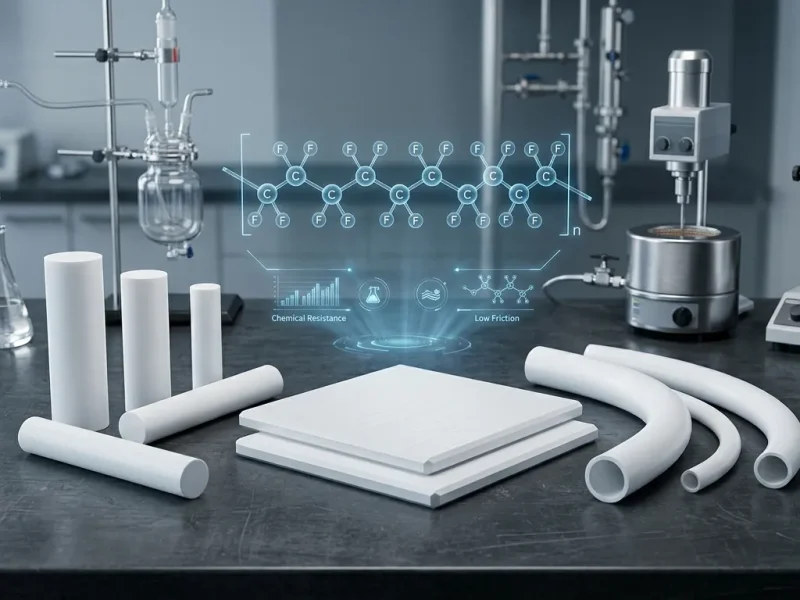
What is PTFE?
Polytetrafluoroethylene (PTFE), best known by the brand name Teflon®, is a high-performance fluoropolymer with the broadest chemical resistance of any plastic. It is characterized by an extremely low coefficient of friction (μ ≈ 0.04), outstanding thermal stability up to 260°C, and virtually universal chemical inertness.
PTFE is available in rod, sheet, and tube forms, typically produced by compression molding or skiving from molded billets. Unlike most thermoplastics, PTFE cannot be melt-processed — it is sintered at high temperature.
Key Properties of PTFE
| Property | Value |
|---|---|
| Continuous Service Temperature | 260°C |
| Melting Point | 327°C (crystalline) |
| Density | 2.15–2.20 g/cm³ |
| Tensile Strength | 20–35 MPa |
| Elongation at Break | 300–600% |
| Coefficient of Friction | 0.04–0.08 (lowest of all solids) |
| Water Absorption | 0.01% (negligible) |
| Dielectric Strength | 60 kV/mm |
Available PTFE Grades
Virgin PTFE
The purest grade. Maximum chemical resistance, highest electrical insulation, and FDA compliance. White/translucent in color. Ideal for food contact, medical, and semiconductor applications.
Glass-Filled PTFE (25% Glass)
Reduces creep and improves dimensional stability. Higher compressive strength and lower thermal expansion. Common for gaskets, seals, and structural components.
Carbon-Filled PTFE (25% Carbon)
Improved wear resistance and thermal conductivity. ESD-dissipative properties. Preferred for dynamic seals, bearings, and piston rings.
Bronze-Filled PTFE (40–60% Bronze)
Highest load-bearing capacity. Excellent thermal conductivity for heat dissipation. Used in heavy-duty bearings, bridge bearings, and wear pads.
PTFE + Graphite
Combines low friction with reduced wear. Suitable for rotary shaft seals and reciprocating applications where dry-running performance is needed.
PTFE vs Filled PTFE: Trade-offs
| Grade | Strength | Wear | Chemical Resistance | FDA |
|---|---|---|---|---|
| Virgin PTFE | Low | Poor | ⭐⭐⭐⭐⭐ | ✅ |
| 25% Glass | Medium | Good | ⭐⭐⭐⭐ | ✅ |
| 25% Carbon | Medium | Excellent | ⭐⭐⭐⭐ | ❌ |
| 60% Bronze | High | Excellent | ⭐⭐⭐ | ❌ |
Industry Applications
🧪 Chemical Processing
PTFE sheet gaskets, pipe linings, expansion joints, and valve seats. Its near-complete chemical inertness makes it the material of choice for aggressive chemical environments.
⚙️ Seals & Bearings
Piston rings, rotary shaft seals, bridge bearings, and slide pads. Filled PTFE grades provide the low friction and wear resistance needed for un-lubricated dynamic applications.
🏥 Medical
Catheter liners, surgical patches, and implant components. PTFE’s biocompatibility and non-stick properties are valuable in medical devices.
🍳 Food Processing
Release sheets, conveyor components, and non-stick surfaces. Virgin PTFE is FDA compliant and does not react with food products.
Limitations of PTFE
- Low mechanical strength — cannot be used for structural components under load
- High creep (cold flow) — deforms under sustained pressure
- Difficult to machine — soft, gummy behavior requires specialized tooling and techniques
- Cannot be melt-processed — no injection molding or extrusion for complex shapes
- Higher cost — significantly more expensive than standard engineering plastics
Frequently Asked Questions
Is PTFE the same as Teflon?
Teflon® is the brand name for PTFE owned by Chemours (DuPont spin-off). All Teflon is PTFE, but not all PTFE is Teflon. Other PTFE brands include Fluon (AGC), Polyflon (Daikin), and generic PTFE from various manufacturers.
What temperature can PTFE withstand?
PTFE can operate continuously at 260°C (500°F) and withstand short-term peaks up to 300°C. At cryogenic temperatures, PTFE remains flexible down to -200°C.
Is PTFE food safe?
Virgin PTFE is FDA compliant for food contact. However, some filled grades contain materials that are not food-grade — verify before specifying.
JEKIN Polymer — Virgin PTFE and filled grades in stock. Request a quote →