
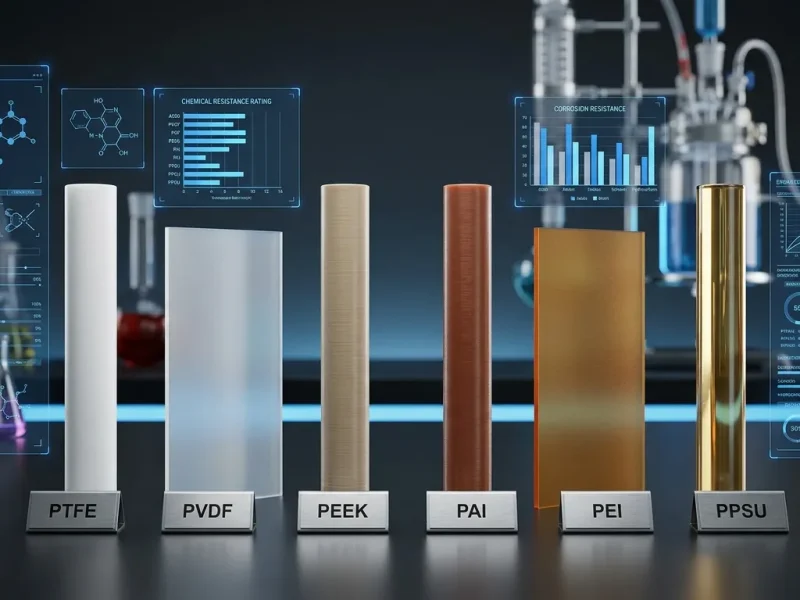
A practical comparison guide for engineers and specifiers
Why Chemical Resistance Matters
When selecting a plastic for chemical processing, semiconductor, or oil & gas applications, chemical resistance is often the deciding factor — not temperature or strength. A material with excellent mechanical properties but poor chemical resistance may fail catastrophically within weeks.
This guide compares the chemical resistance profiles of the most common high-performance engineering plastics across key chemical classes.
Chemical Resistance Overview
| Chemical Class | PTFE | PVDF | PEEK | PAI | PEI | PPSU |
|---|---|---|---|---|---|---|
| Strong Acids (H₂SO₄, HCl) | ⭐⭐⭐⭐⭐ | ⭐⭐⭐⭐⭐ | ⭐⭐⭐⭐ | ⭐⭐⭐⭐ | ⭐⭐⭐⭐ | ⭐⭐⭐ |
| Strong Bases (NaOH, KOH) | ⭐⭐⭐⭐⭐ | ⭐⭐⭐⭐ | ⭐⭐⭐ | ⭐⭐⭐ | ⭐⭐⭐ | ⭐⭐⭐⭐ |
| Organic Solvents | ⭐⭐⭐⭐⭐ | ⭐⭐⭐ | ⭐⭐⭐⭐ | ⭐⭐⭐⭐ | ⭐⭐⭐ | ⭐⭐⭐ |
| Hydrocarbons (Oil/Gas) | ⭐⭐⭐⭐⭐ | ⭐⭐⭐⭐ | ⭐⭐⭐⭐⭐ | ⭐⭐⭐⭐⭐ | ⭐⭐⭐⭐ | ⭐⭐⭐⭐ |
| Halogens (Cl₂, Br₂) | ⭐⭐⭐⭐⭐ | ⭐⭐⭐⭐⭐ | ⭐⭐ | ⭐ | ⭐ | ⭐⭐ |
| Hot Water/Steam | ⭐⭐⭐⭐⭐ | ⭐⭐⭐⭐ | ⭐⭐⭐⭐⭐ | ⭐⭐ | ⭐⭐⭐⭐⭐ | ⭐⭐⭐⭐⭐ |
Detailed Chemical Resistance by Material
PTFE — The Chemical Champion
PTFE is virtually inert to all chemicals except molten alkali metals and fluorine gas at high temperature. It offers the broadest chemical resistance of any plastic. However, its poor mechanical properties (low strength, high creep) limit its use to non-structural applications like linings, gaskets, and seals.
PVDF — Robust Fluoropolymer
PVDF offers excellent resistance to acids, halogens, and UV but is attacked by strong bases (especially at high temperature) and polar organic solvents like acetone and MEK. Its mechanical strength is significantly better than PTFE.
PEEK — Broad but Not Universal
PEEK resists most organic solvents, hydrocarbons, and dilute acids/bases. It is attacked by concentrated sulfuric acid and nitric acid. PEEK’s chemical resistance combined with its mechanical strength makes it the preferred metal replacement for chemically aggressive environments.
PAI — Strong but Moisture-Sensitive
PAI resists hydrocarbons and dilute acids well but is sensitive to strong bases and steam. Its higher moisture absorption can cause dimensional changes — a key consideration for sealed assemblies.
Quick Selection Guide
| If your chemical environment is… | Choose |
|---|---|
| Concentrated acids at high temperature | PTFE, PFA, or PVDF |
| Hydrocarbons at 200°C+ | PEEK or PAI |
| Steam sterilization (repeated) | PEI or PEEK |
| Chlorine / bleach / halogens | PVDF or PTFE |
| Acidic cleaning agents | PEI or PVDF |
| Alkaline / caustic solutions | PTFE or PPSU |
Important Caveats
- Chemical resistance varies with temperature — a material that resists a chemical at 20°C may fail at 80°C
- Stress concentration accelerates chemical attack — avoid sharp corners in chemically exposed parts
- Fillers affect resistance — glass-filled grades have different chemical resistance profiles than unfilled
- Always validate with immersion testing using your specific chemical composition and operating temperature
Frequently Asked Questions
Which engineering plastic has the best chemical resistance?
PTFE (and PFA) offer the broadest chemical resistance. Among structural plastics, PEEK offers the best combination of chemical resistance and mechanical performance.
Does PEEK resist all chemicals?
No. PEEK is attacked by concentrated sulfuric acid and strong nitric acid. It also has limited resistance to halogens (chlorine, bromine).
Is chemical resistance affected by temperature?
Yes, significantly. Most chemical resistance charts show data at room temperature. Performance at elevated temperatures should always be verified with the material supplier.
JEKIN Polymer — We provide chemical resistance data and application-specific guidance for every material we supply. Contact our technical team →