
As the hydrogen energy industry enters large-scale deployment, material supply chain stability and precise material selection are becoming critical — and often underestimated — competitive factors.
1. Industry Background: Why Material Selection Is a Hidden System Variable
The global hydrogen energy industry is rapidly transitioning from technology validation to large-scale commercial deployment. The rollout of fuel cell vehicles, stationary power systems, and alkaline water electrolysis equipment is creating unprecedented demand for high-performance structural and functional materials.
In component design, material selection is often the critical variable determining system reliability and total lifecycle cost — particularly in areas requiring simultaneous resistance to high temperatures, chemical attack, electrical stress, and dimensional change.
Sulfone-based engineering plastics — led by PSU and PPSU — are increasingly entering the decision frameworks of hydrogen system engineers and procurement teams worldwide.
Procurement Perspective:
Material selections in hydrogen energy projects tend to be “lock-in” decisions. The initial choice carries long-term implications for supply chain stability, certification cycles, and re-qualification costs. Getting material positioning right at the project’s early stage is far more cost-effective than switching later.
2. The Sulfone Family: Three Materials, Three Performance Tiers
Sulfone polymers are a class of high-performance engineering plastics defined by the presence of sulfone groups (-SO₂-) in the polymer backbone. Three commercial grades dominate the market:
PSU
- Tg ≈ 187°C
- Best electrical insulation
- Excellent film-forming
- Good polar solvent resistance
- Lowest cost
PPSU
- Tg ≈ 220°C
- Highest impact strength
- Best chemical resistance
- Steam sterilization compatible
- Premium applications
PESU
- Tg ≈ 225°C
- Best balanced properties
- Superior film formation
- Dominant in membrane apps
- Mid-range cost
For hydrogen energy applications, PPSU delivers the most well-rounded performance profile: superior impact resistance provides structural integrity under high-pressure conditions; stronger chemical resistance handles alkaline, acidic, and hydrogen environments; and a higher service temperature covers the core operating range of fuel cell systems.
3. PPSU vs PSU: Key Performance Comparison
The following comparison focuses on the dimensions most critical for hydrogen energy procurement decisions:
| Property | PSU | PPSU | H₂ Application Weight |
|---|---|---|---|
| Glass Transition Temp. | ≈ 187°C | ≈ 220°C ▲ | ★★★★★ |
| Continuous Use Temp. | 150°C | 180°C ▲ | ★★★★★ |
| Impact Strength | Moderate | Highest in family ▲ | ★★★★☆ |
| Chemical Resistance | Moderate | Excellent ▲ | ★★★★★ |
| Dimensional Stability | Good | Excellent ▲ | ★★★★☆ |
| Electrical Insulation | Best in family ▲ | Good | ★★★☆☆ |
| Processability | Good | Good | ★★★☆☆ |
| Material Cost | Lower ▲ | Higher | ★★☆☆☆ |
| Domestic Supply Maturity | High ▲ | Medium (improving) | ★★★☆☆ |
Selection guidance:
Choose PPSU for components exposed to elevated temperatures, high pressure, or strong chemical media. PSU offers better value for insulation, film-forming, or low-temperature sealing applications. Using both materials strategically across different components within the same system is a common and cost-effective approach.
4. Component-Level Material Mapping in Fuel Cell Systems
Fuel cell systems are structurally complex, with significantly different operating conditions across components. Material selection must be evaluated part by part:
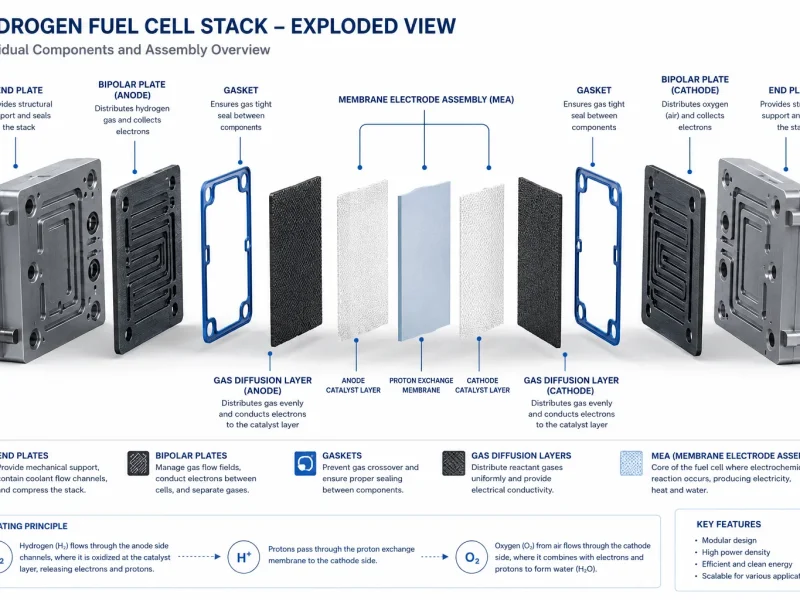
End Plate — Recommended: PPSU Sheet
Must withstand stack compression load. Requires high rigidity, low creep, and dimensional stability. PPSU sheet is the mainstream choice for high-temperature stacks.
Insulation Frame — PSU or PPSU
Requires excellent electrical insulation and chemical resistance. Selection depends on specific temperature requirements.
Seal Substrate — Recommended: PPSU Thin Sheet
Contacts hydrogen gas, coolant, and alkaline media. Requires outstanding chemical inertness and dimensional stability. PPSU thin sheet (e.g. 2–3mm) is the typical specification.
Water Management Components — Recommended: PSU
PSU’s superior film-forming properties and selective permeability make it the dominant material for moisture separation membrane substrates.
Connectors & Fittings — Recommended: PPSU Rod
Exposed to hydrogen gas lines; requires pressure resistance and corrosion resistance. PPSU rod stock machined to final geometry is the standard production route.
Alkaline Electrolyzer Structural Components — Recommended: PPSU
Alkaline water electrolysis exposes materials to concentrated KOH. PPSU significantly outperforms PSU in this environment and is the preferred choice for insulating separators.
5. Market Intelligence: Supply Chain Restructuring in Progress
Global Market Scale
In 2025, the global sulfone polymer market is valued at approximately USD 1.3 billion, stabilizing after previous pricing volatility. The Asia-Pacific region accounts for 39.7% of global demand — the world’s largest consuming market — with a projected compound annual growth rate of 5.4% through 2032.
Key Supply-Side Developments
The global sulfone market has long been dominated by Syensqo (formerly Solvay), BASF, and Sumitomo Chemical, with the top three players holding close to 80% of production capacity. Over the past three years, however, Chinese domestic producers have expanded capacity at a pace that exceeds most market forecasts:
1. PSU localization is largely complete; prices have declined significantly
Multiple Chinese producers have completed PSU capacity buildouts. Bisphenol-A PSU has achieved the highest domestic substitution rate, with prices declining substantially from historical levels.
2. PPSU localization lags behind; high-end grades retain import dependence
The key PPSU intermediate 4,4′-biphenol has historically been sourced from overseas, acting as the primary constraint on domestic PPSU production. As domestic intermediate capacity comes online, PPSU localization will accelerate — but premium grades will retain import dependence in the near term.
3. Hydrogen energy is the highest-growth application segment for sulfone polymers
Demand from fuel cell programs is transitioning from small-batch qualification to volume procurement, raising the bar on material consistency, batch traceability, and supplier qualification capability.
4. Semi-finished stock forms are a supply chain bottleneck
Most hydrogen system integrators lack in-house extrusion capability and depend on external suppliers for machining-ready sheet, rod, and tube stock. Suppliers with proven extrusion consistency are gaining structural pricing leverage within the value chain.
Procurement Takeaway:
The current period represents a strategic window for establishing PPSU supply chain relationships — domestic cost advantages are materializing while the number of qualified semi-finished stock suppliers remains limited. Establishing stable supply arrangements now will provide meaningful cost and lead time advantages as hydrogen programs scale.
6. PPSU / PSU Stock Forms and Supply Specifications
Sulfone polymers are available as extruded sheet, rod, and tube stock, providing the semi-finished forms required for downstream component machining:
| Form | Typical Dimensions | Primary Applications | Machining Route |
|---|---|---|---|
| Sheet / Plate | 1–50mm thick, custom width | End plates, insulation frames, seal substrates, structural parts | CNC milling, stamping, thermoforming |
| Rod / Bar | Ø 5–200mm | Fittings, valve bodies, connectors, spacers | Turning, drilling, thread cutting |
| Tube | OD 10–150mm, custom wall | Flow channels, sleeves, insulating conduit | Cutting, expanding, machining |
Thin-gauge sheet (e.g. 2–3mm) places demanding requirements on extrusion temperature control and cooling uniformity. Consistent thin-sheet production yield is a direct indicator of a supplier’s process capability — and a significant driver of incoming quality performance for downstream machining operations.
Conclusion
PPSU and PSU are not competing materials in hydrogen energy systems — they are complementary. Precise material selection based on component-specific operating conditions is the most effective way to balance performance reliability with procurement cost.
As China’s sulfone polymer supply chain continues to mature, the accessibility of high-performance semi-finished stock will improve further. Establishing partnerships with capable extrusion suppliers now gives hydrogen system manufacturers a meaningful head start on material supply security.
For technical datasheets or samples of PPSU / PSU sheet and rod stock, please contact us.