
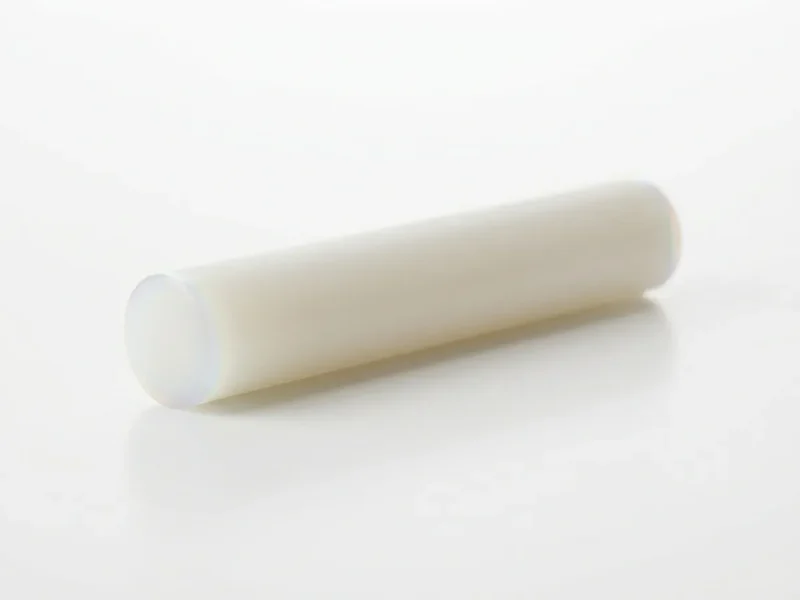
What is PVDF?
Polyvinylidene Fluoride (PVDF) is an opaque, semi-crystalline fluoropolymer that combines the excellent chemical resistance of fluoroplastics with significantly better mechanical strength and machinability than PTFE or PFA.
PVDF has a melting point of 171°C and offers continuous service at 140°C. It is supplied in rod, sheet, and tube forms through extrusion, and is widely used in chemical processing, semiconductor, water treatment, and battery manufacturing.
Key Properties of PVDF
| Property | Value |
|---|---|
| Continuous Service Temperature | 140°C (150°C peak) |
| Melting Point | 171°C |
| Density | 1.78 g/cm³ |
| Tensile Strength | 50–60 MPa |
| Tensile Modulus | 2.0–2.5 GPa |
| Hardness | Shore D 75–80 |
| Water Absorption | 0.04% (virtually none) |
| UV Resistance | Excellent |
| Flammability | UL94 V-0 |
PVDF vs Other Fluoropolymers
| Property | PVDF | PTFE | PFA |
|---|---|---|---|
| Strength | Highest | Low | Medium |
| Chemical Resistance | Excellent | Virtually inert | Virtually inert |
| Max Temp | 140°C | 260°C | 260°C |
| Machinability | Excellent | Poor (soft/gummy) | Poor |
| UV Resistance | Excellent | Excellent | Excellent |
| Cost | Lower | Higher | Highest |
Advantages of PVDF
- Best strength of any fluoroplastic — PVDF is the only fluoropolymer with structural mechanical properties
- Excellent chemical resistance — resists acids, bases, halogens, and most solvents
- Zero moisture absorption — dimensionally stable in wet environments
- UV and weather resistant — ideal for outdoor applications
- Purity — suitable for high-purity water and semiconductor applications
- Good machinability — machines cleanly unlike PTFE
Industry Applications
🧪 Chemical Processing
Valves, pump housings, pipe fittings, filter plates, and tank linings requiring chemical resistance with mechanical strength.
🔬 Semiconductor
High-purity piping, wet bench components, and CMP equipment — PVDF does not leach metal ions.
🔋 Battery Manufacturing
PVDF is the standard binder material for lithium-ion battery electrodes. Also used in battery housing components and electrolyte handling equipment.
💧 Water Treatment
Membrane housings, filter plates, and piping in water and wastewater treatment due to chlorine resistance and zero moisture absorption.
🏗️ Building & Construction
PVDF coatings on architectural metal panels — one of the most weather-resistant coating systems available.
Machining Guidelines
- Tooling: Standard carbides work well — PVDF is not abrasive
- Speeds: Moderate speeds prevent heat buildup — PVDF can soften if overheated
- Chip control: Produces long stringy chips — use proper chip breakers
- Coolant: Air or water mist recommended
Frequently Asked Questions
Is PVDF food safe?
Yes. PVDF is FDA compliant for food contact applications. It is used in food processing equipment where chemical resistance and purity are required.
Can PVDF be used for high-temperature applications?
PVDF is rated for continuous use up to 140°C. For higher temperature fluoropolymer applications, PTFE (260°C) or PFA (260°C) are more suitable.
Is PVDF recyclable?
Yes. PVDF is thermoplastic and can be reprocessed. JEKIN encourages proper recycling of PVDF waste and offcuts.
JEKIN Polymer — Engineering-grade PVDF, PTFE, PFA, PEEK, PAI, PPSU, PET. Request a quote →