
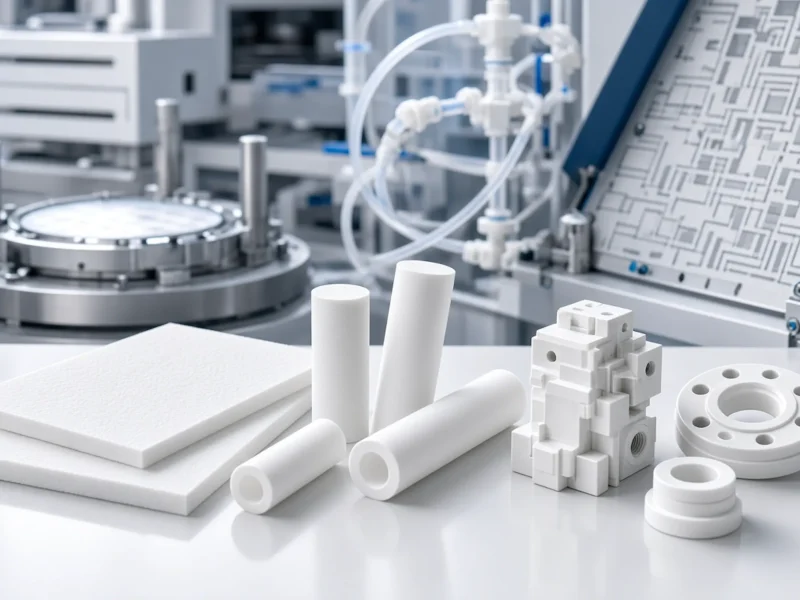
Polytetrafluoroethylene, better known as PTFE, is not a new material.
For decades, PTFE has been widely used in chemical processing, sealing systems, electrical insulation, industrial machinery and fluid handling because of its outstanding chemical resistance, wide service temperature range, low friction and excellent dielectric properties.
However, PTFE is attracting renewed attention in 2026.
The reason is not simply rising prices or increasing production capacity. More importantly, the structure of the PTFE market is changing.
China continues to expand PTFE production capacity, while semiconductor manufacturing, high-frequency electronics, high-purity fluid handling and other advanced industries are creating new requirements for material purity, electrical performance, consistency and qualification.
The key question is therefore no longer:
How much PTFE can the industry produce?
A more important question is:
What type of PTFE can meet the requirements of high-value applications?
1. Understanding the PTFE Supply Chain
PTFE is part of the broader fluorochemical industry.
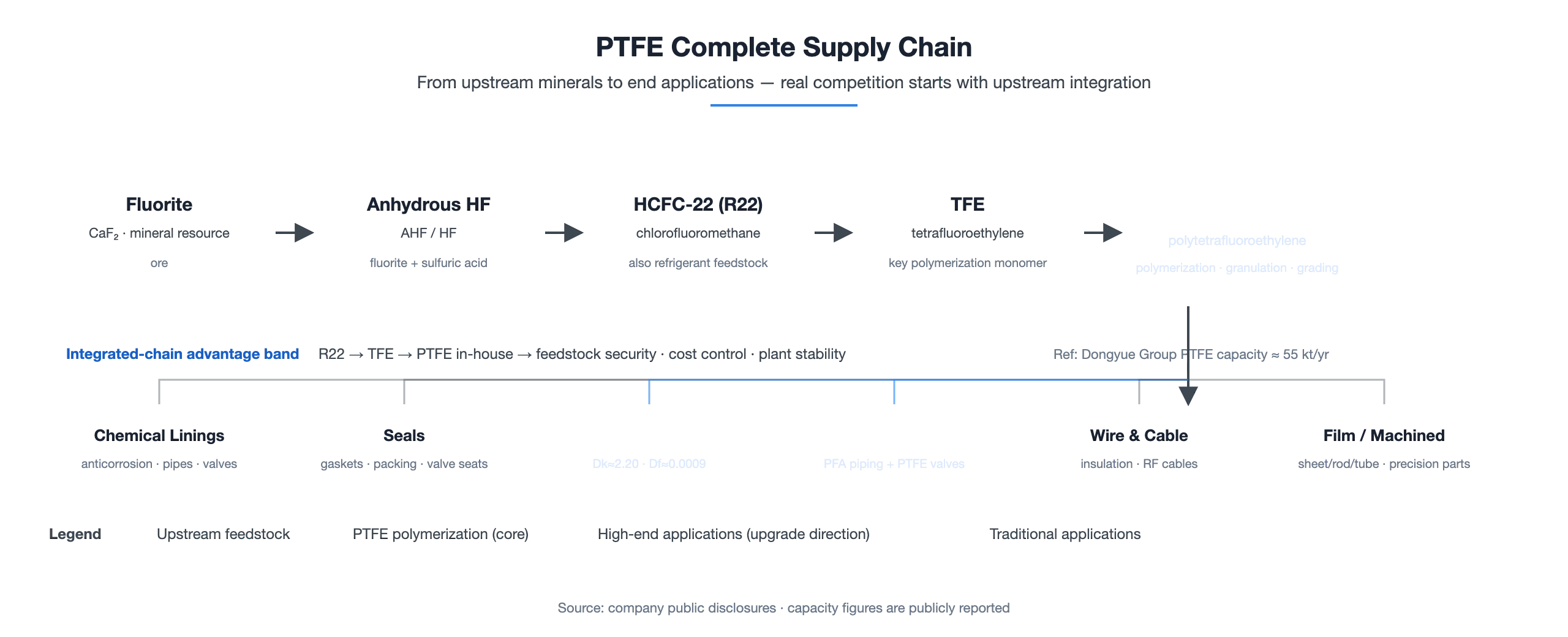
A simplified PTFE supply chain can be described as:
Fluorite → Anhydrous Hydrogen Fluoride → HCFC-22 (R22) → TFE → PTFE Resin → Semi-Finished Products and Components
Tetrafluoroethylene, or TFE, is the key monomer used to produce PTFE.
For large PTFE producers, access to upstream fluorochemical raw materials can therefore have a significant impact on cost control, production stability and supply security.
Companies with vertically integrated production systems may have advantages in securing raw materials and managing production costs.
This also means that PTFE pricing cannot be analyzed only at the resin level.
Changes in upstream fluorochemicals, plant maintenance, operating rates and supply-demand conditions can eventually affect PTFE market prices.
2. China Has Significant PTFE Capacity — but Product Structure Matters More
China is already one of the world’s largest PTFE manufacturing bases.
Several major fluorochemical producers operate large-scale PTFE facilities.
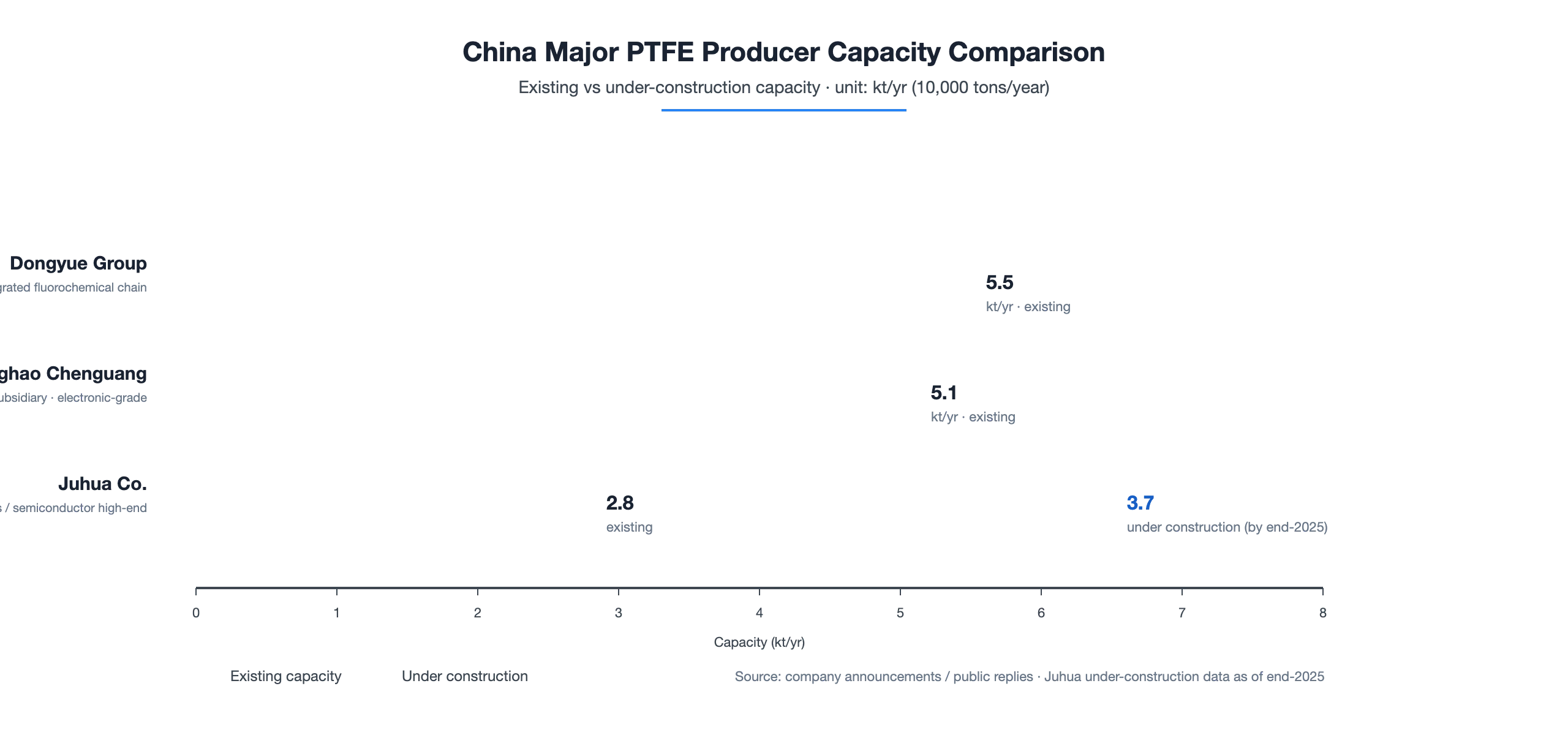
Dongyue Group has previously disclosed approximately 55,000 metric tons of annual PTFE production capacity.
Zhonghao Chenguang, part of Haohua Chemical Science & Technology, has reported approximately 51,000 metric tons of annual PTFE capacity and has also developed industrial-scale production capability for high-end electronic-grade PTFE.
Juhua Group had approximately 28,000 metric tons of completed PTFE production capacity by the end of 2025, with additional capacity under development.
These figures indicate that the Chinese PTFE market cannot simply be described as a market suffering from overall supply shortages.
Industry operating-rate data also supports this view.
During several months of 2026, China’s PTFE industry capacity utilization remained around the 60–75% range.
If PTFE were experiencing a severe industry-wide shortage, such utilization levels would be difficult to explain.
A more accurate conclusion is:
The PTFE market is facing structural supply-demand differences rather than a simple shortage of total capacity.
General-purpose suspension PTFE and dispersion PTFE remain highly competitive.
However, electronic-grade, high-purity, specialty processing grades and application-specific PTFE materials have much higher technical barriers.
This difference is becoming increasingly important.
3. PTFE Prices Increased in 2026 — but the Market Is Not Moving in One Direction
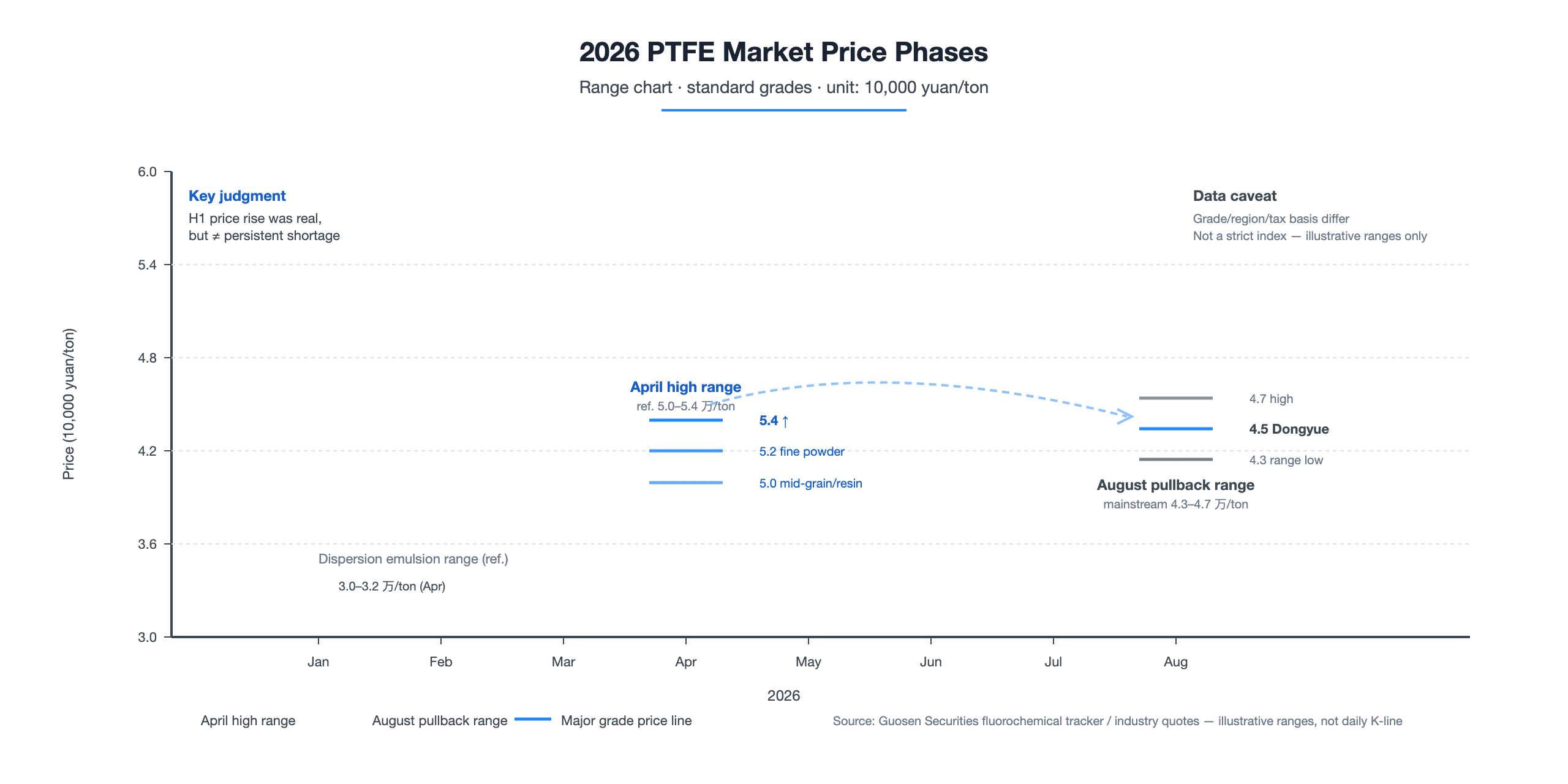
PTFE prices experienced a noticeable increase during the first half of 2026.
Market data published during April showed reference prices for several PTFE grades at relatively high levels.
Suspension molding grades were reported around RMB 50,000–52,000 per metric ton, while fine-powder suspension grades were around RMB 52,000–53,000 per ton.
Dispersion resin prices were also reported around RMB 50,000–54,000 per ton, depending on grade and supplier.
The increase was influenced by several factors, including upstream raw-material costs, production maintenance, temporary supply reductions and downstream inventory replenishment.
However, the market started to show more differentiation later in the year.
By August 2026, market quotations for some standard suspension PTFE grades had moved back toward approximately RMB 43,000–47,000 per ton.
Different suppliers, grades, regions and transaction conditions can result in significantly different pricing, so these numbers should not be treated as a single universal PTFE price index.
Nevertheless, the overall trend provides an important message:
PTFE prices increased significantly during part of 2026, but this does not mean that the industry has entered a permanent shortage cycle.
For manufacturers and distributors, the more important question is not whether PTFE prices will rise another few thousand RMB per ton.
The more important question is:
Which PTFE products can maintain long-term value and premium pricing?
4. High-Frequency Electronics Are Creating New Opportunities for PTFE
One of the most interesting developments for PTFE is its growing importance in high-frequency electronic applications.
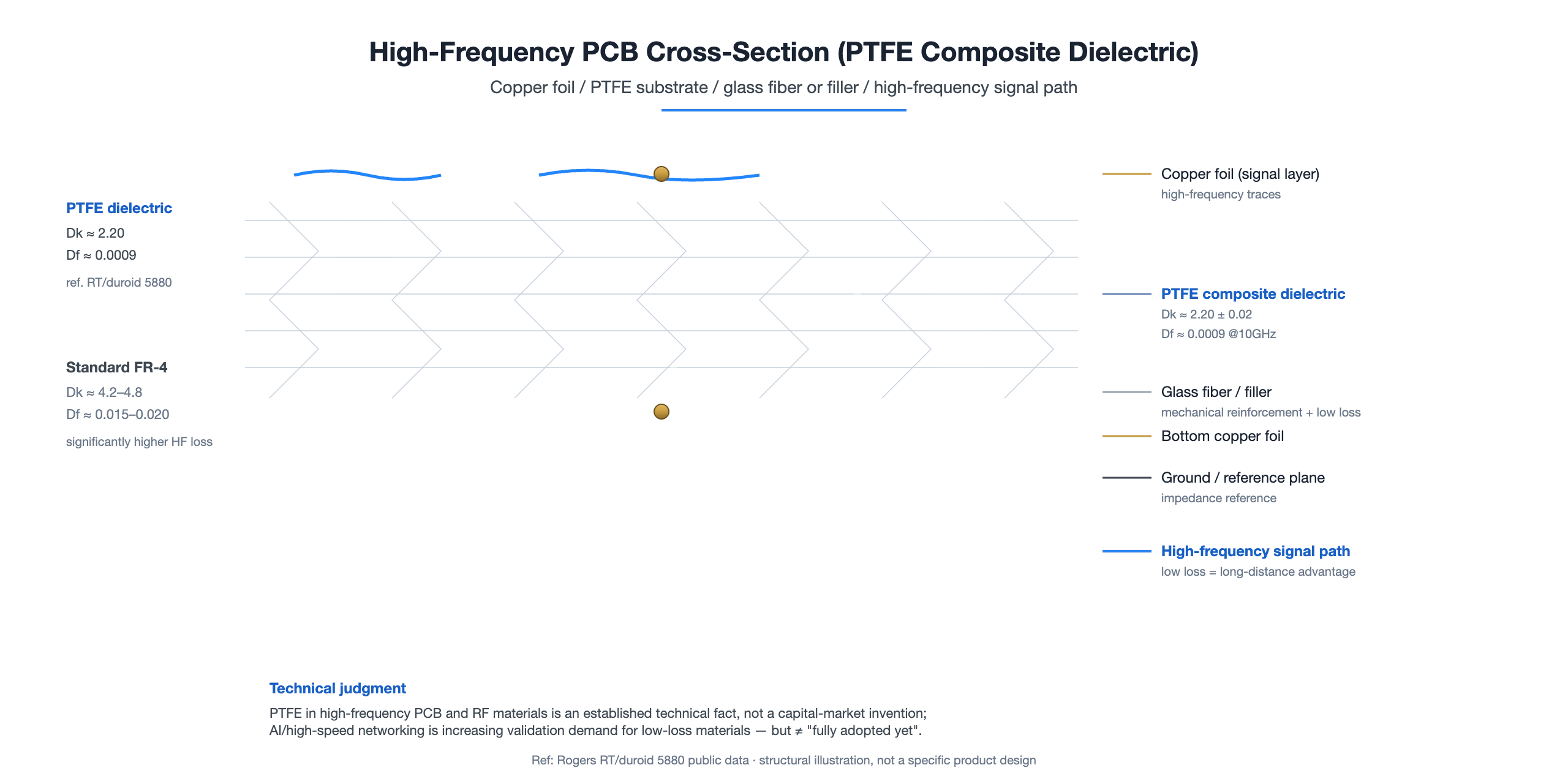
PTFE offers a low dielectric constant and extremely low dielectric loss, making it well suited for high-frequency signal transmission.
This is not a new application.
PTFE-based laminates have been used for decades in RF, microwave and high-frequency PCB applications.
For example, Rogers Corporation’s RT/duroid 5880 laminate uses PTFE-based composite technology and offers a dielectric constant of approximately 2.20 with very low dielectric loss.
What has changed is the scale and performance requirement of modern electronic systems.
AI servers, high-speed networking equipment, advanced switches and next-generation communication hardware require increasingly strict signal-integrity performance.
As data rates increase, dielectric loss becomes more important.
This is one reason PTFE and other ultra-low-loss materials are receiving renewed attention in the electronics industry.
However, an important distinction must be made.
There is a difference between:
PTFE being technically suitable for high-frequency systems
and
a specific technology company having fully adopted PTFE across a future product platform.
Industry discussions around AI hardware and next-generation networking should therefore be interpreted carefully.
The long-term opportunity is real, but material qualification, supplier approval, reliability testing and volume production normally take time.
For PTFE suppliers, this is actually positive.
High-value materials markets are usually built through technical qualification rather than short-term speculation.
5. Semiconductor Applications Represent Another High-Value Market
Semiconductor manufacturing uses large quantities of aggressive chemicals, including acids, bases, solvents and ultra-pure process chemicals.
Materials used in these environments must provide excellent chemical resistance while minimizing particle generation, ionic contamination and extractables.
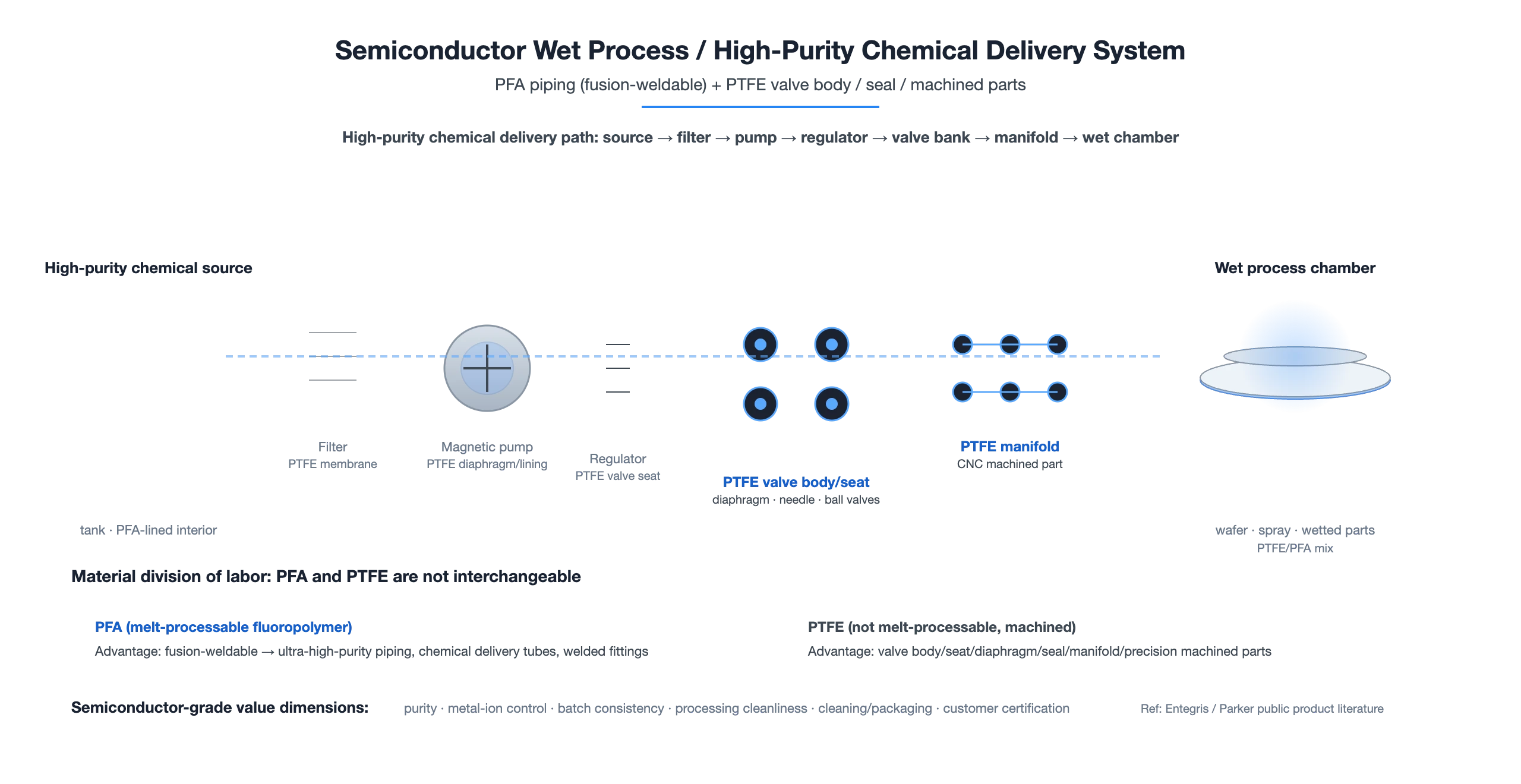
For this reason, fluoropolymers are widely used in semiconductor fluid-handling systems.
PTFE and PFA can be found in valves, fittings, regulators, diaphragms, seals, manifolds and other wetted components.
However, PTFE and PFA should not be treated as interchangeable materials.
PFA offers melt-processability and excellent weldability, which makes it particularly suitable for ultra-high-purity tubing and chemical distribution systems.
PTFE, on the other hand, is widely used for seals, valve seats, diaphragms, machined bodies and corrosion-resistant precision components.
For semiconductor customers, material selection involves much more than simply specifying “PTFE.”
Important factors include:
- Material purity
- Trace metal content
- Particle control
- Batch consistency
- Machining cleanliness
- Cleaning procedures
- Packaging conditions
- Material traceability
- Customer qualification
This is where the difference between standard industrial PTFE and semiconductor-grade fluoropolymer materials becomes significant.
6. PTFE Competition Is Moving From Capacity to Grade, Quality and Qualification
In the past, PTFE producers were often evaluated mainly by production capacity.
How many tons can a company produce every year?
That question still matters, but it is no longer enough.
Future PTFE competitiveness will increasingly depend on whether a supplier can consistently provide materials for demanding applications.
Important questions include:
Can the supplier produce electronic-grade PTFE?
Can trace metals and contamination be controlled?
Can dielectric performance remain stable from batch to batch?
Can the supplier provide grades optimized for special extrusion, films, filled compounds or precision machining?
Can long-term quality consistency be maintained?
Can the supplier support extended customer qualification programs?
These capabilities create much stronger barriers to entry than simply adding another production line.
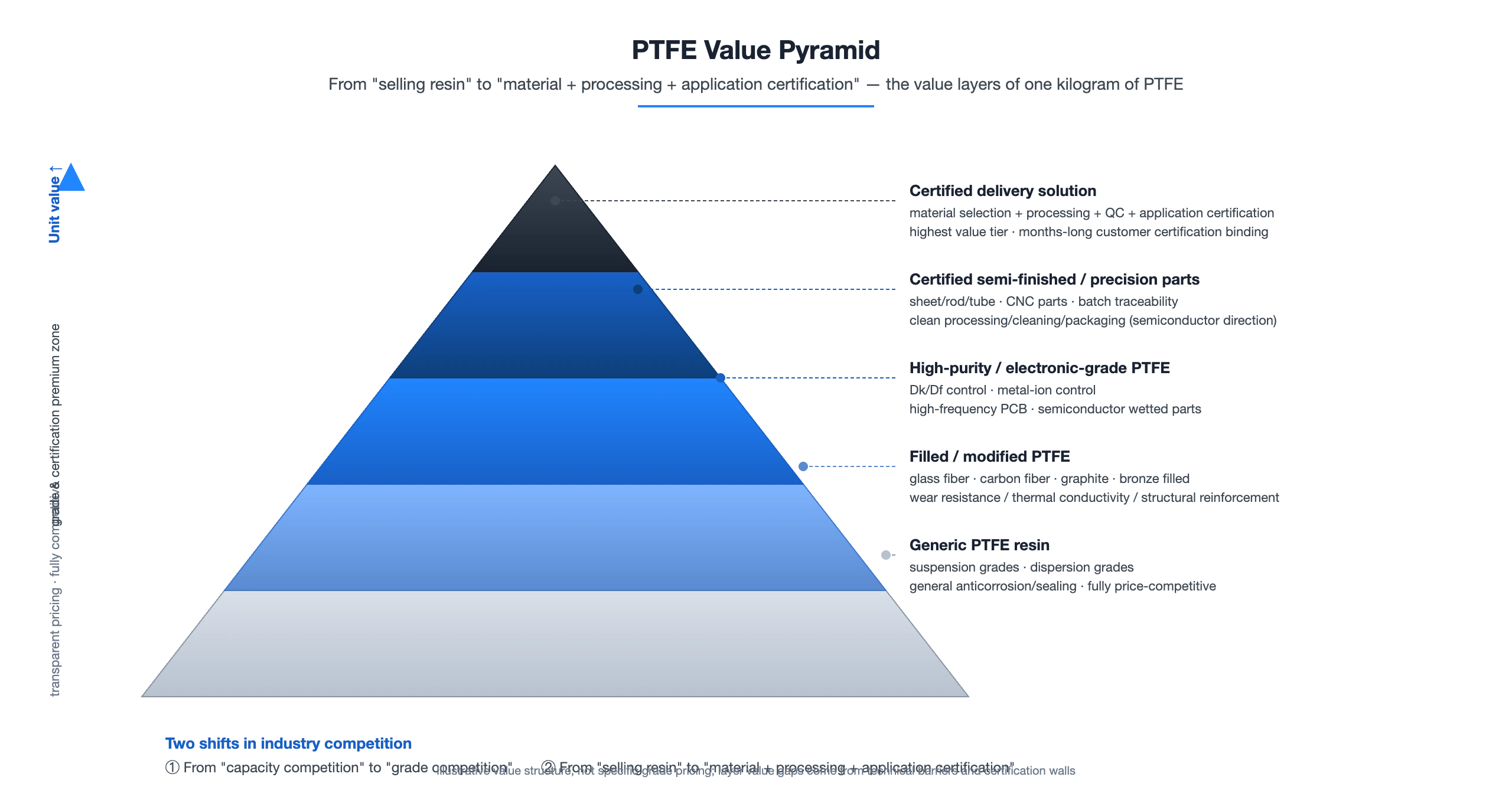
The competitive direction of the PTFE industry can therefore be summarized in two transitions:
From capacity competition to grade competition
and
from selling resin to providing material, processing and application solutions.
7. Where Are the Opportunities for PTFE Sheet, Rod, Tube and Machining Suppliers?
The development of high-value PTFE markets does not mean every company needs to become a resin producer.
For manufacturers of PTFE sheets, rods, tubes and CNC-machined components, some of the most practical opportunities exist further downstream.
Standard PTFE sheets and rods will remain highly competitive products.
Simply offering “PTFE material” is unlikely to create a sustainable competitive advantage.
Higher value comes from combining material expertise with manufacturing capability.
Examples include:
- Using traceable and stable PTFE raw materials
- Supplying glass-filled, carbon-filled, graphite-filled or bronze-filled PTFE
- Improving dimensional stability of molded and skived products
- Controlling internal stress in semi-finished shapes
- Precision CNC machining to customer drawings
- Providing material certificates and batch traceability
- Supporting dimensional inspection and quality documentation
- Clean machining, cleaning and packaging for semiconductor applications
In these applications, the customer is no longer purchasing only one kilogram of PTFE.
The customer is purchasing a complete solution that may include:
Material selection + semi-finished product manufacturing + precision machining + quality control + application support
The value created per kilogram of PTFE can therefore be very different.
8. PFAS Regulation Remains a Long-Term Factor
PTFE is a fluoropolymer, which means the ongoing PFAS regulatory discussion in Europe must also be monitored.
However, it is inaccurate to say that Europe has already completely banned PTFE.
As of 2026, the European Chemicals Agency continues to evaluate the proposed EU-wide PFAS restriction.
Regulatory authorities are still assessing different applications, socioeconomic impacts and possible derogations for specific uses.
The final regulatory framework has not yet been fully implemented.
For PTFE manufacturers and exporters, PFAS regulation should therefore be treated as a long-term compliance factor rather than an immediate universal ban.
Companies supplying European customers should continue monitoring:
- Regulatory developments
- Application-specific exemptions
- Material traceability requirements
- Customer compliance requests
- Environmental and sustainability documentation
These requirements are likely to become increasingly important for international suppliers.
9. The Future of PTFE Is About Application Value, Not Only Production Volume
China already has significant PTFE manufacturing capacity.
PTFE prices also do not move continuously in one direction.
The more important change is that PTFE is entering applications with increasingly strict requirements for purity, electrical performance, reliability and manufacturing quality.
Traditional chemical processing, sealing and industrial applications will remain an important foundation for PTFE demand.
At the same time, high-frequency electronics, semiconductor equipment, high-purity fluid handling, specialty membranes and advanced filled PTFE compounds are creating new value layers within the industry.
This means that future PTFE market analysis should not focus only on one question:
How many additional tons of PTFE capacity are being built?
We should also ask:
What grade of PTFE is being produced?
Which applications can it enter?
Has the material been qualified by end users?
For the PTFE industry, the next stage of competition may not be determined by who produces the most material.
It may be determined by who can create the highest application value from each kilogram of PTFE.
The difference between PTFE used in a standard industrial gasket and PTFE used in a high-frequency electronic system or semiconductor manufacturing component can be enormous.
That difference is where many of the industry’s future opportunities may be found.