
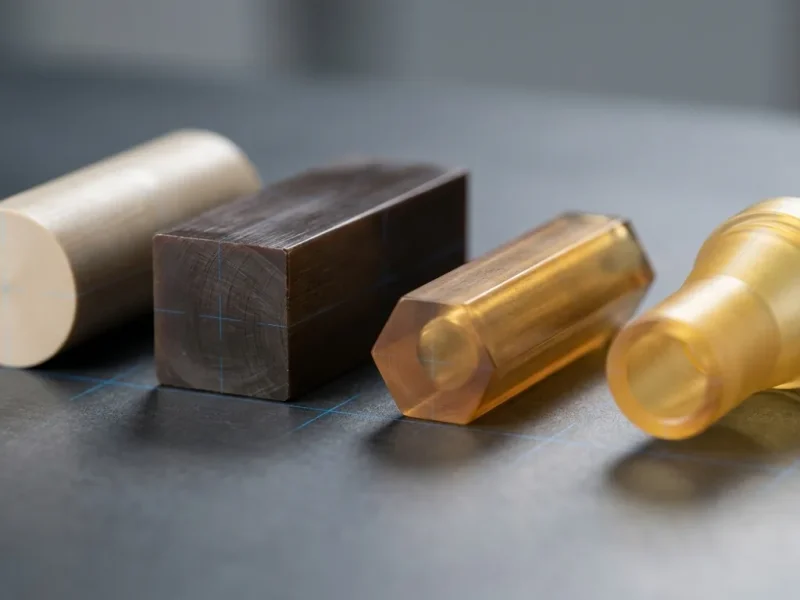
Most engineers default to PEEK for any demanding application. And PEEK is exceptional — continuous service at 260°C, outstanding chemical resistance, excellent mechanical strength. But it’s not always the optimal choice.
Consider PAI (Torlon). It’s harder than PEEK, with the highest strength and stiffness of any melt-processable plastic (tensile strength up to 262 MPa). For structural components in automotive transmissions or aerospace bearings where creep resistance at high loads is non-negotiable, PAI frequently outperforms PEEK by a margin that justifies the premium. [PAI vs PEEK]
Or PEI (Ultem). It offers a lower continuous service temperature (170°C) but delivers UL94 V-0 flammability inherently — no additives. For aerospace interior brackets or medical sterilization trays, PEI gives you regulatory compliance and optical transparency at roughly half the cost of PEEK. [PEI vs PEEK]
And PPSU (Radel R) — often overlooked — has the highest impact resistance of any amorphous high-temp plastic. It withstands repeated steam sterilization cycles without embrittling. That alone makes it the go-to for medical device handles and food processing components.
The real cost savings don’t come from negotiating lower prices.
They come from choosing the material that precisely matches your operating envelope.
Over-speccing (using PEEK when PEI suffices) or under-speccing (using PPSU when you need PAI) both cost you — the former in raw material expense, the latter in field failures.
We’ve published detailed one-to-one comparison pages covering mechanical, thermal, and chemical tradeoffs across all six of our material families.
If you’re sourcing high-performance plastics and want data-driven guidance rather than “just quote me PEEK,” the links are below.
What’s the most over-engineered spec you’ve inherited on a project?