
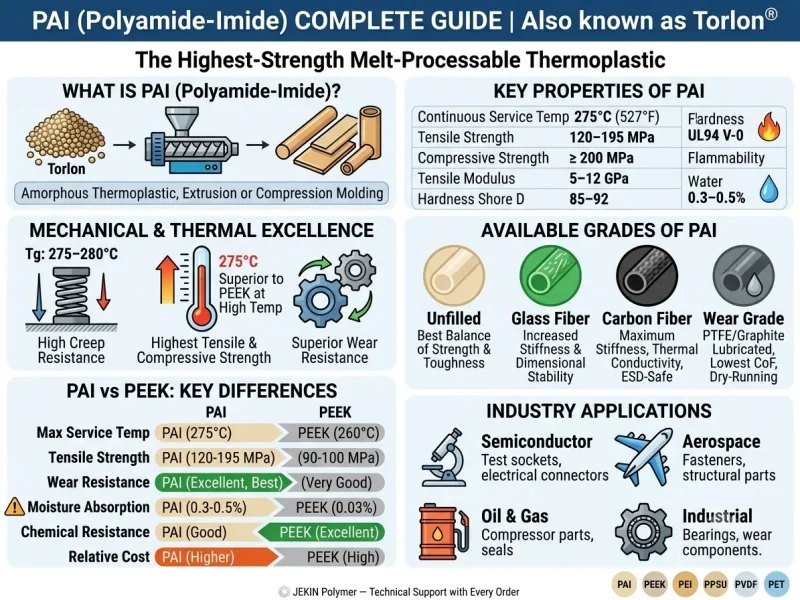
Also known as Torlon® — The highest-strength melt-processable thermoplastic
What is PAI (Polyamide-Imide)?
Polyamide-Imide (PAI), commercially known as Torlon®, is widely regarded as the highest-performing melt-processable thermoplastic available. It is produced in semi-finished forms — rods, sheets, and tubes — through extrusion or compression molding, using Torlon® granules or powder.
As an amorphous thermoplastic, PAI delivers an exceptional balance of thermal stability, chemical resistance, and wear performance at continuous service temperatures up to 275°C (527°F).
Key Properties of PAI
| Property | Value |
|---|---|
| Continuous Service Temperature | 275°C |
| Tensile Strength | 120–195 MPa (grade-dependent) |
| Compressive Strength | ≥ 200 MPa |
| Tensile Modulus | 5–12 GPa |
| Hardness | Shore D 85–92 |
| Flammability Rating | UL94 V-0 |
| Water Absorption | 0.3–0.5% (higher than PEEK) |
Mechanical Excellence
PAI offers the highest tensile and compressive strength of any melt-processable thermoplastic. Even at 250°C, it retains mechanical properties that other plastics lose at much lower temperatures. Key mechanical advantages include:
- Exceptional wear resistance — superior to PEEK in dry-running conditions
- Low coefficient of thermal expansion — excellent dimensional stability
- High creep resistance — even under continuous load at elevated temperatures
- Excellent toughness and rigidity across a wide temperature range
Thermal Performance
With a glass transition temperature (Tg) of 275–280°C, PAI can operate continuously where PEEK (260°C) reaches its limits. It exhibits minimal property loss after prolonged exposure at 250°C, making it the go-to material for extreme thermal environments.
Chemical Resistance
PAI resists a wide range of chemicals, including hydrocarbons, acids, and alkalis. However, it has higher moisture absorption than PEEK — this can cause dimensional changes in humid environments. It is also sensitive to prolonged exposure to saturated steam. Designers must account for these factors when selecting PAI for sealed or steam-exposed applications.
Available Grades of PAI
Unfilled PAI (Torlon 4203 / 4203L)
The baseline grade offering the best balance of strength, toughness, and wear resistance. Light beige color. Ideal for structural components requiring high strength.
Glass Fiber Reinforced PAI (Torlon 4301 / 5030)
30% glass fiber content increases stiffness and reduces thermal expansion. Preferred for precision components requiring high dimensional stability at temperature.
Carbon Fiber Reinforced PAI (Torlon 4275 / 7130)
Maximum stiffness with improved thermal conductivity and lower friction. ESD-safe properties make it ideal for semiconductor tooling.
Wear Grade PAI (Torlon 4347 / 4535)
PTFE/graphite lubricated for extreme dry-running performance. The lowest coefficient of friction in the PAI family. Used in un-lubricated bearings, seals, and bushings.
PAI vs PEEK: Key Differences
| Characteristic | PAI (Torlon) | PEEK |
|---|---|---|
| Max Service Temp | 275°C | 260°C |
| Tensile Strength | 120–195 MPa | 90–100 MPa |
| Wear Resistance | Excellent (best in class) | Very Good |
| Moisture Absorption | 0.3–0.5% | 0.03% |
| Chemical Resistance | Good | Excellent |
| Relative Cost | Higher | High |
Industry Applications
🔬 Semiconductor
Test sockets, electrical connectors, and insulation components where dimensional stability at high temperature is critical.
🛩️ Aerospace
Fasteners, insulation components, and structural parts requiring high strength-to-weight ratio at extreme temperatures.
⛽ Oil & Gas
Compressor components, pump parts, and labyrinth seals in downhole and subsea environments.
⚙️ Industrial Machinery
Bearings, wear components, and parts requiring high strength and hardness in continuous high-temperature operation.
Machining Guidelines for PAI
PAI machines similarly to PEEK but requires attention to its higher hardness:
- Drying: 150°C for 4+ hours before machining (moisture absorption affects dimensional stability)
- Tooling: Carbide or diamond-tipped tools recommended
- Speeds: Moderate cutting speeds — avoid heat buildup
- Coolant: Water-soluble coolant recommended to prevent thermal stress
- Annealing: Stress relief at 200–220°C for finished parts with tight tolerances
Frequently Asked Questions
Is PAI the same as Torlon?
Torlon® is the brand name for Solvay’s polyamide-imide (PAI) material. All Torlon grades are PAI, but not all PAI is Torlon. JEKIN sources Torlon® and equivalent PAI grades.
Is PAI stronger than PEEK?
Yes. PAI offers 30–60% higher tensile strength than unfilled PEEK, along with superior wear resistance. However, PEEK has better chemical resistance and significantly lower moisture absorption.
Can PAI be used in medical applications?
PAI is not typically used for implantable medical devices. For medical applications requiring high-temperature performance, PEEK medical grade is the preferred choice. PAI is used in medical equipment components that do not require biocompatibility certification.
What is the maximum operating temperature of PAI?
PAI can operate continuously at 275°C, with short-term peaks up to 300°C. This makes it the highest-temperature melt-processable thermoplastic available.
Does PAI absorb moisture?
Yes. PAI has higher moisture absorption (0.3–0.5%) than PEEK (0.03%). This must be accounted for in part design for humid environments.
JEKIN Polymer — Engineering-grade PAI, PEEK, PEI, PPSU, PVDF, PET. Technical support with every order. Contact us for specifications and pricing →