
Introduction
Polysulfone (PSU) and Polyphenylsulfone (PPSU) are both high-performance amorphous thermoplastics belonging to the polysulfone family. They offer transparency, dimensional stability, and hydrolysis resistance — but they differ significantly in impact strength, temperature range, and chemical resistance.
This guide helps engineers and procurement professionals choose the right material for their specific application.
Material Overview
What is PSU (Polysulfone)?
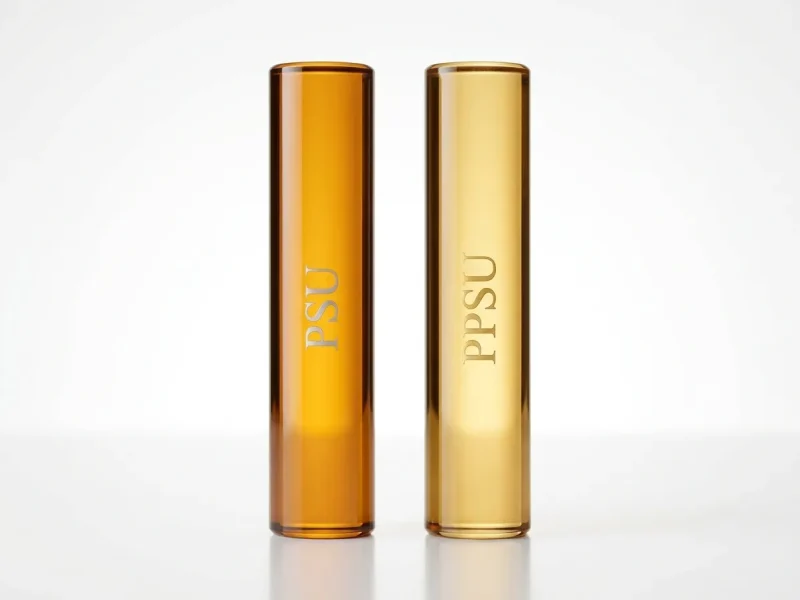
PSU is an amber-transparent amorphous thermoplastic with excellent dimensional stability and hydrolysis resistance. It can operate continuously at 160°C and withstand repeated steam sterilization. PSU is one of the most cost-effective high-temperature transparent plastics.
What is PPSU (Polyphenylsulfone)?
PPSU is the highest-performing polysulfone family member. It offers the best impact resistance, highest temperature capability (180°C continuous), and superior hydrolysis resistance. PPSU is naturally a light amber-golden color. Its toughness is unmatched among transparent high-temperature plastics.
Property Comparison: PPSU vs PSU
| Property | PSU | PPSU |
|---|---|---|
| Continuous Service Temp | 160°C | 180°C |
| Glass Transition Temp (Tg) | 187°C | 220°C |
| Tensile Strength | 70 MPa | 70–80 MPa |
| Impact Strength (Izod) | 7 kJ/m² | 60 kJ/m² (≈9× stronger) |
| Elongation at Break | 30–80% | 60–120% |
| Flammability | UL94 V-0 | UL94 V-0 |
| Steam Sterilization | 1,000+ cycles | 3,000+ cycles |
| Relative Cost | Lower | Higher |
Key Differences
Impact Resistance
The single biggest difference: PPSU is approximately 9× tougher than PSU. If your application involves repeated impact, thermal cycling, or requires robust snap-fit designs, PPSU is the clear choice.
Temperature Capability
Both materials offer excellent high-temperature performance. PPSU has a 20°C advantage in continuous service (180°C vs 160°C) and a higher Tg (220°C vs 187°C), making it suitable for applications closer to the performance of PEI.
Chemical Resistance
Both PSU and PPSU offer excellent resistance to aqueous acids, alkalis, and detergents. However, neither should be exposed to strong organic solvents (ketones, chlorinated hydrocarbons) under stress. PPSU has slightly better resistance to environmental stress cracking.
Steam Sterilization
Both materials excel in medical sterilization environments. PSU withstands over 1,000 autoclave cycles. PPSU withstands over 3,000 cycles before significant property degradation — making it the preferred material for reusable medical devices.
When to Choose PSU
- Cost-sensitive applications requiring high-temperature performance
- Applications where transparency is needed but extreme impact is not a factor
- Medical device components with moderate mechanical stress
- Sight glasses, fluid handling components, and filter housings
When to Choose PPSU
- Impact-prone medical devices (surgical instrument handles, dental tools)
- Reusable components requiring thousands of autoclave cycles
- Aerospace interior components requiring toughness and FST compliance
- Food service components exposed to harsh cleaning chemicals
Available Forms
Both PSU and PPSU are available from JEKIN in:
- Rod: Ø10–200 mm
- Sheet: 3–80 mm thickness
- Tube: Custom dimensions
Frequently Asked Questions
Can PSU and PPSU be sterilized?
Yes. Both withstand steam autoclaving, gamma radiation, and EtO. PPSU is preferred for high-cycle sterilization due to its superior impact retention.
Are PSU and PPSU food safe?
Yes. Both are FDA compliant for repeated food contact. PPSU is widely used in commercial food service equipment (baby bottle components, food pans).
Which is more expensive — PSU or PPSU?
PPSU is generally 30–50% more expensive than PSU due to its superior impact performance and higher temperature capability.
JEKIN Polymer — Engineering-grade PPSU, PSU, PEEK, PAI, PEI, PET, PVDF. Contact us for technical guidance →