
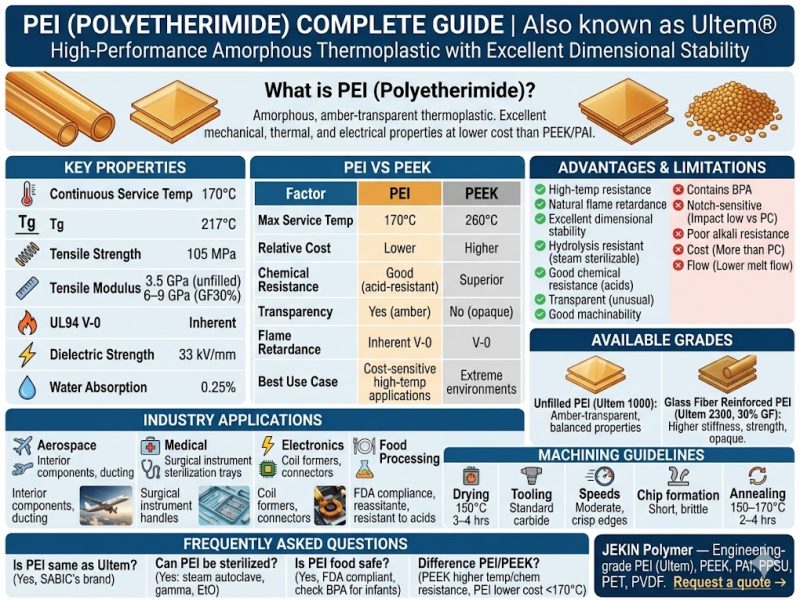
Also known as Ultem® — High-performance amorphous thermoplastic with excellent dimensional stability
What is PEI (Polyetherimide)?
Polyetherimide (PEI), best known under the brand name Ultem®, is an amorphous amber-transparent thermoplastic offering an excellent balance of mechanical, thermal, and electrical properties at a cost lower than PEEK or PAI.
PEI is supplied in extruded rod and sheet forms, as well as injection-molded granules. The natural grade is translucent amber, while glass-filled grades are opaque.
Key Properties of PEI
| Property | Value |
|---|---|
| Continuous Service Temperature | 170°C |
| Glass Transition Temperature (Tg) | 217°C |
| Tensile Strength | 105 MPa (unfilled) |
| Tensile Modulus | 3.5 GPa (unfilled), 6–9 GPa (GF30%) |
| Flammability | UL94 V-0 (inherent — no additives) |
| Dielectric Strength | 33 kV/mm |
| Water Absorption | 0.25% |
Advantages of PEI
- High temperature resistance: 170°C continuous use, Tg of 217°C
- Natural flame retardance: UL94 V-0 without additives — low smoke density
- Excellent dimensional stability: Low CLTE, low creep even at elevated temperatures
- Hydrolysis resistant: Withstands repeated steam sterilization
- Good chemical resistance: Particularly to acids and chlorinated cleaners
- Transparent: Amber-transparent in natural grade — unusual for a high-temperature plastic
- Good machinability: Easier to machine than PEEK or PAI
Limitations of PEI
- Contains BPA: Restricted for certain infant/children’s product applications
- Notch-sensitive: Impact strength is lower than PC or PPSU — design requires careful attention to radii
- Poor alkali resistance: Especially at elevated temperatures — avoid strong bases
- Cost: More expensive than PC, PSU, and standard engineering plastics
- Flow: Lower melt flow than standard plastics — requires higher processing temperatures
PEI vs PEEK: Choosing the Right Material
| Factor | PEI (Ultem) | PEEK |
|---|---|---|
| Max Service Temp | 170°C | 260°C |
| Relative Cost | Lower | Higher |
| Chemical Resistance | Good (acid-resistant) | Superior |
| Transparency | Yes (amber) | No (opaque) |
| Flame Retardance | Inherent V-0 | V-0 |
| Best Use Case | Cost-sensitive high-temp applications | Extreme environments |
Available Grades
Unfilled PEI (Ultem 1000)
Baseline grade. Amber-transparent, good balance of properties for general high-temperature applications.
Glass Fiber Reinforced PEI (Ultem 2300 — 30% GF)
Higher stiffness and strength. Reduced elongation. Opaque. Ideal for structural components requiring dimensional stability.
Industry Applications
🛩️ Aerospace
Interior components, antenna housings, and ducting. PEI’s inherent flame retardance and low smoke density meet FAR 25.853 requirements.
🏥 Medical
Surgical instrument handles, sterilization trays, and medical device components that require repeated autoclave cycles.
⚡ Electronics
Coil formers, fuse housings, and connectors requiring high dielectric strength and thermal stability.
🍽️ Food Processing
Components requiring FDA compliance and resistance to acidic cleaning agents.
Machining Guidelines for PEI
- Drying: 150°C for 3–4 hours recommended
- Tooling: Standard carbide tools work well
- Speeds: PEI machines cleanly at moderate speeds — produces crisp edges
- Chip formation: Produces short, brittle chips — easy to manage
- Annealing: 150–170°C for 2–4 hours for stress relief in precision parts
Frequently Asked Questions
Is PEI the same as Ultem?
Ultem® is SABIC’s brand name for PEI (polyetherimide). All Ultem grades are PEI. Other PEI brands are available from different manufacturers.
Can PEI be sterilized?
Yes. PEI withstands steam autoclaving (134°C), gamma radiation, and ethylene oxide (EtO) sterilization — making it popular for medical device applications.
Is PEI food safe?
Yes. PEI is FDA compliant for repeated food contact applications. However, due to BPA content, check specific regulations for infant/children’s food contact.
What is the difference between PEI and PEEK?
PEEK offers higher temperature resistance (260°C vs 170°C) and superior chemical resistance, but costs significantly more. PEI offers the best value in applications below 170°C.
JEKIN Polymer — Engineering-grade PEI (Ultem), PEEK, PAI, PPSU, PET, PVDF. Request a quote →