
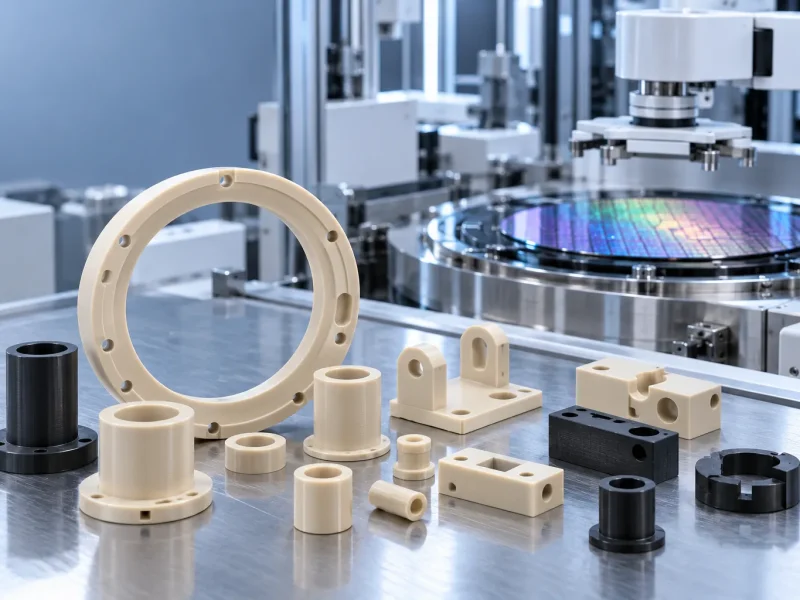
PEEK’s chemistry did not suddenly change. What changed is how the material is specified. A January 2026 PlasticsToday review describes a “PEEK 2.0” context: higher-heat and more processable PEEK/PAEK grades, broader commercial sourcing options, and clearer operational rules for pellet handling and documentation.
Technical baseline: a graded family
Classic unfilled PEEK remains well documented. Victrex™ PEEK 450G publicly reports Tg onset ~143°C, melting temperature ~343°C, UL 746B electrical RTI of 260°C, and UL94 V-0 at defined thickness.
Industry coverage also points to:
- Higher-heat extensions — e.g., reported Tg/Tm uplifts for Syensqo KetaSpire PEEK XT
- Wider process window — Victrex LMPAEK as a lower-melt PAEK option that expands a graded family rather than replacing standard PEEK
Plus glass/carbon compounds, tribology and ESD grades.
Define the duty window first, then pick the grade inside the family.
Why semiconductor buyers keep asking
Suppliers continue to position PEEK for wafer tools, wet benches and chemical delivery because of chemical resistance plus low outgassing/extractables concerns—often under combined heat and aggressive media.
APO Research’s public summary maps typical parts (CMP rings, handling fingers/trays, guides, bushings, insulators, robot/gripper parts, fixtures) and notes role split: high-purity fluoropolymers often in wet/chemical delivery; PEEK/PPS often in CMP, handling and precision structures.
Market estimates (research-firm figures, not Jekin data): about USD 3.59 bn (2025) → USD 4.08 bn (2026) → USD 6.50 bn (2032), ~8.04% CAGR 2026–2032. Cite the source; do not treat as universal law.
Public China-side signals show qualification work, not slogans: Junhua reported passing a multi-day supplier audit by a leading domestic semiconductor-equipment firm in 2025; ZYPEEK highlighted ESD stock shapes and wafer-carrier-oriented grades at CSEAC 2026. The buyer question is shifting from “is it PEEK?” to “can you prove purity, dimensional hold, ESD window and lot traceability?”
Supply caution: capacity ≠ high-end qualification
Growth in general industrial PEEK is not the same as ultra-high-purity semiconductor grades, aerospace airworthiness, or other high-compliance tiers. Buyers also commonly ask for food-contact documentation—still gated by written files. OEM and parts-maker gates often sit on QMS, clean machining, traceability and consistency—not name proximity alone. Jekin’s content and inquiry-path compliance ceiling is food-contact / food-grade; list required files in the RFQ—this article makes no certification claim.
Commercial and regulatory context
Standardized PEEK fasteners (e.g., Essentra’s 2025 launch) show high-performance polymers entering catalogs once dominated by metals. EU pellet-loss rules (Regulation (EU) 2025/2365) add containment and documentation duties for pellet handlers. Food-contact and similar high-documentation frameworks also tighten file packs even when they do not name PEEK—list needs in the RFQ; Jekin’s content ceiling is food-contact at most.
Practical RFQ checklist
- Temperature × chemistry × load/wear (including life or replacement cycle)
- Cleanliness/outgassing metrics with test methods—not verbal “high purity”
- Electrical window: insulating / ESD / conductivity allowed (critical for CF grades)
- Stock-shape condition: rod/sheet/tube, stress relief, allowance, inspection, tolerances
- Document pack: grade identity, TDS, COA, lot traceability (+ compliance records if needed)
Jekin Polymer publicly supplies PEEK and related high-performance stock shapes and machined parts (jekinpolymer.com, PEEK, stock shapes). This article does not claim any specific fab or OEM qualification for Jekin.